Coding Theory: A Playful Introduction #SoME5
Let's cut through the noise, one bit at a time
This post is designed for people with absolutely no idea about coding theory. Refer to the introduction in case you want to skip the basic stuff.
Switch to light-mode and a bigger display for better experience.
A Problem
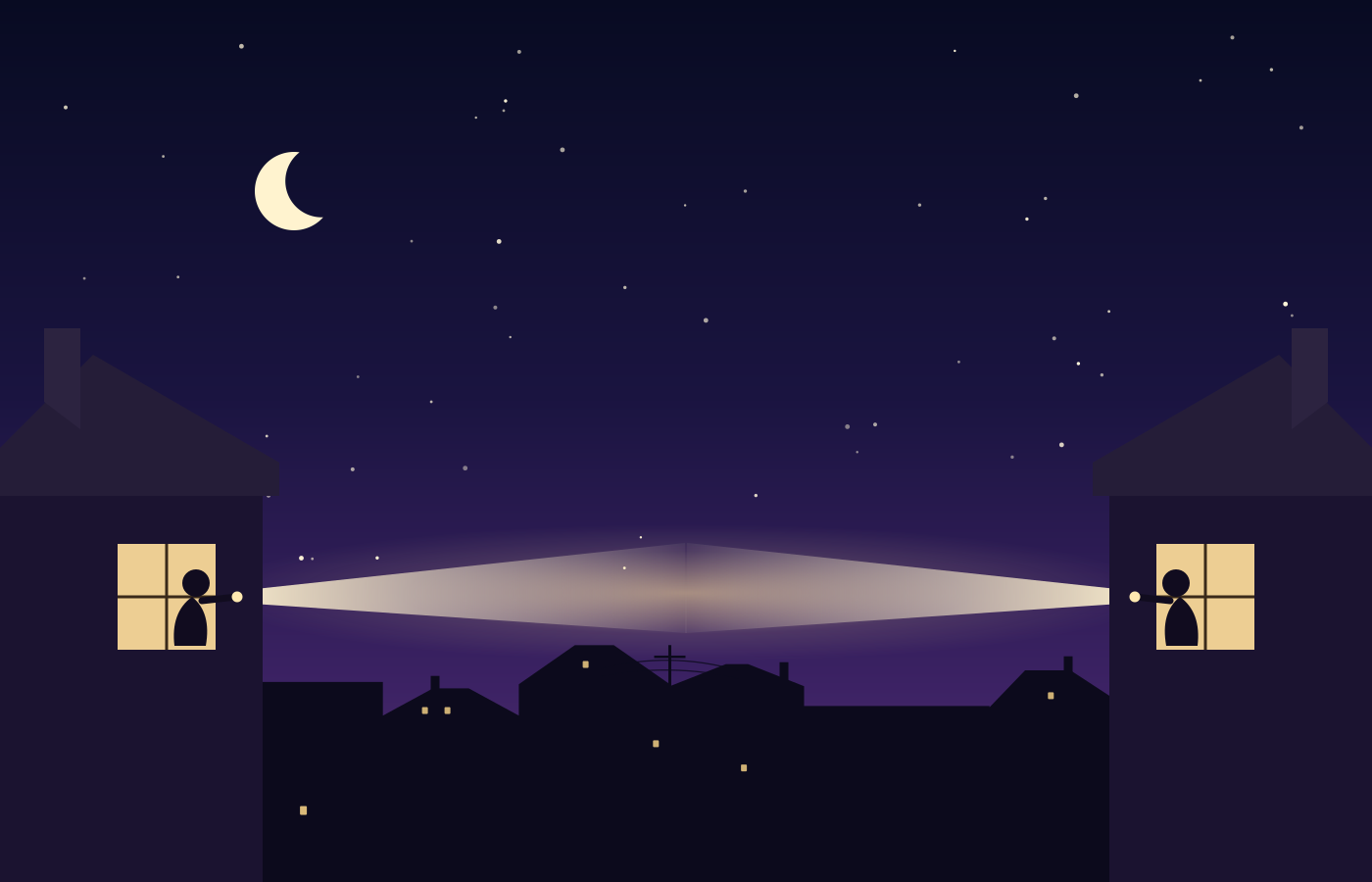
Imagine you are a smol child in 1900s; you want to talk with your best friend at late night who is also your opposite neighbour. You don’t want to disturb others (or perhaps wanna talk in secret), so you try speaking softly but the distance is too long to reach them. Thankfully, both of you can see each other from your bedroom windows. The problem is how will you two communicate? Each of you has a flashlight 🔦 that you can use. Think about it!1
Codes for Communication
Attempt 1 (Drawing)
Well of course, you turn ON your flashlight and start drawing letters, you create the shape of \(\textrm{I}\) with one single vertical stroke of your flashlight and then your friend can see the line and understand it. then you start drawing \(\textrm{L}\) with one vertical stroke and an horizontal stroke below it from where you ended and realise that it will look as $\textrm{L}$ to your friend, so you need to draw $\textrm{L}$ then your friend interprets it correctly as \(\textrm{L}\). then you draw an oval \(\textrm{O}\) but wonder what if its interpreted as \(\textrm{0}\), then you send \(\textrm{V}\) with two simple storkes, then when you send $\textrm{E}$ you soon realise a bigger problem, interpreting symbols with many strokes isn’t easy afterall the old strokes dont stay in the air until you finish the letter. So you wanted to do something more precise.
Attempt 2 (Blinking)
Till now, your flashlight was always ON, you realise you haven’t turned it OFF since you started and then it clicks, what if you tried blinking (turning your flashlight ON and then OFF). To keep it simple, you assign \(\textrm{A}\) as \(1\) blink, \(\textrm{B}\) as \(2\) blinks, and so on \(\textrm{Z}\) as \(26\) blinks. This works! To send \(\textrm{I LOVE}\), you first blink your flashlight \(9\) times then wait for some time and blink it \(12, 15, 22\) and \(5\) times. Your friend counts the number of blinks (\(\#\)blinks) and computes the letter sent. Of course, you need to make sure there is sufficient pauses between blinks, otherwise \(\textrm{I L}\) can be interpreted as \(\textrm{U}\) with \(9+12=21\) blinks. also, you will need different pauses between \(\textrm{I}\), \(\textrm{L}\) and \(\textrm{L}\), \(\textrm{O}\) as one separates words and one separates letters of same word. Now \(\textrm{I LOVE}\) is \(9+12+15+22+5=63\) blinks, and it gets the job done. We can do better, but first celebrate as you have just discovered Coding Theory 🎊
Introduction
What you developed was a code, i.e., a system for transferring information (in this case among people). This code helped you communicate the message (something to be sent) by converting it into an encoded message (something that’s actually sent). A message is made up of symbols (letters in our case) and an encoded message is made up of codewords (\(\#\)blinks in our case). When you were converting a letter into \(\#\)blinks, you were encoding and your friend was decoding when they were converting \(\#\)blinks back into the letter. Coding Theory is the study of such codes.
This shouldn’t be confused with the popular term with the same name ‘coding’ which means writing a computer program i.e., instructions for a computer.
Now, let’s get back to the problem.
Attempt 3 (Frequency Analysis)
This discovery is great and as a result you want to send \(\textrm{I LOVE CODING THEORY}\) next, well guess what, it turns out to be \(206\) blinks, too long :(
But then, here you find your first breakthrough, you realise there is no need to map \(\textrm{A$-$Z}\) to \(\textrm{1$-$26}\) sequentially. From your futuristic experience of Scrabble, you know that letter \(\textrm{E}\) comes up the most in english langauge, so why not assign it \(1\) blink instead of \(5\). and we can go ahead and assign second most frequent letter of the alphabet \(\textrm{T}\) as \(2\) blinks, to the third most frequent \(\textrm{A}\) as \(3\) blinks, and so on until the least frequent \(\textrm{Q}\) and \(\textrm{Z}\) as \(25\) and \(26\) blinks respectively, this ensures that we use fewer blinks for popular letters and hence can send our message faster.
Below plot, gives an idea of frequency of each letter. Convince yourself that for any two pair of letters, it is better to represent the more frequent letter with lesser \(\#\)blinks to minimise the expected total number of blinks.
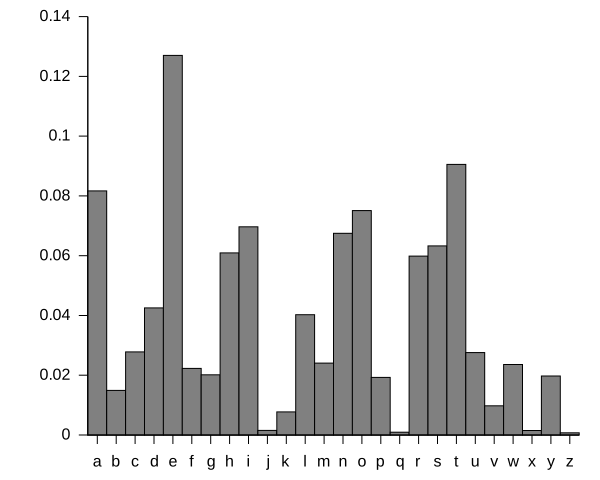
 Frequency Analysis ($\%$) of English letters (Image by Nandhp Public domain, via Wikimedia Commons)
| Letter | \(\#\)blinks | Letter | \(\#\)blinks |
|---|---|---|---|
| \(\textrm{A}\) | \(3\) | \(\textrm{N}\) | \(6\) |
| \(\textrm{B}\) | \(20\) | \(\textrm{O}\) | \(4\) |
| \(\textrm{C}\) | \(12\) | \(\textrm{P}\) | \(19\) |
| \(\textrm{D}\) | \(10\) | \(\textrm{Q}\) | \(25\) |
| \(\textrm{E}\) | \(1\) | \(\textrm{R}\) | \(9\) |
| \(\textrm{F}\) | \(16\) | \(\textrm{S}\) | \(7\) |
| \(\textrm{G}\) | \(17\) | \(\textrm{T}\) | \(2\) |
| \(\textrm{H}\) | \(8\) | \(\textrm{U}\) | \(13\) |
| \(\textrm{I}\) | \(5\) | \(\textrm{V}\) | \(21\) |
| \(\textrm{J}\) | \(23\) | \(\textrm{W}\) | \(15\) |
| \(\textrm{K}\) | \(22\) | \(\textrm{X}\) | \(24\) |
| \(\textrm{L}\) | \(11\) | \(\textrm{Y}\) | \(18\) |
| \(\textrm{M}\) | \(14\) | \(\textrm{Z}\) | \(26\) |
Using this table, \(\textrm{I LOVE CODING THEORY}\) is shortened to \(138\) blinks, a whopping \(33\%\) reduction!
Punctuation
Before optimising our code further, let’s discuss the important topic of punctuation. When we are sending our blinks, there are actually three levels of pauses that we need to take between blinks for accurate decoding, these are
- pauses between blinks of same letter
- pauses between blinks of different letters
- pauses between blinks of different words
The technical term for these pauses is punctuation and it has been an important part of our codes till now.
Attempt 4 (Morse Code)
Let’s try to formalise our previous system. Instead of writing blinks over and over again, we can use codewords to represent our encoded message, so the letter \(\textrm{A}\) means \(\bullet\), \(\textrm{B}\) means \(\bullet\bullet\), \(\textrm{C}\) means \(\bullet\bullet\bullet\), and so on. This is essentially Base \(1\) system of counting. Where, we literally have same number of \(\bullet\)’s (the length of the codeword) as number of blinks, akin to how ancient people used number of sticks to count their number of sheeps.
Notice that in this way, both our message and the corresponding encoded message can be represented by different sets of symbols, for our message the symbols are the alphabets whereas for the encoded message, the symbols are the dots, each specific collection of such dots form a codeword.
Here, we were using only one symbol \(\bullet\), but what if we use two symbols instead? That’s Base \(2!\) With two symbols (say \(\bullet\) and \(-\) (called bits)) the possibilities explode, initially we had one codeword for every length, now there are \(2^n\) codewords with length \(n\), for eg, for length \(2\), possible codewords are \(\bullet\bullet\), \(\bullet-\), \(-\bullet\) and \(--\). As, we now have many more codewords of short length, this will again shorten the average length of the codewords and in turn, hopefully reduce \(\#\)blinks. But, what does the symbols \(\bullet\) and \(-\) represent here? Well, in Morse Code, people denote \(\bullet\) by a short blink (dot) and \(-\) by long blink (dash), in particular, a blink in a dash is three times as long as a dot. Here, every letter of the alphabet can be written as a codeword comprised of dots and dashes as shown in below table
| Letter | Symbol | Letter | Symbol |
|---|---|---|---|
| \(\textrm{A}\) | \(\bullet -\) | \(\textrm{N}\) | \(-\bullet\) |
| \(\textrm{B}\) | \(-\bullet\bullet\bullet\) | \(\textrm{O}\) | \(---\) |
| \(\textrm{C}\) | \(-\bullet-\bullet\) | \(\textrm{P}\) | \(\bullet--\bullet\) |
| \(\textrm{D}\) | \(-\bullet\bullet\) | \(\textrm{Q}\) | \(--\bullet-\) |
| \(\textrm{E}\) | \(\bullet\) | \(\textrm{R}\) | \(\bullet-\bullet\) |
| \(\textrm{F}\) | \(\bullet\bullet-\bullet\) | \(\textrm{S}\) | \(\bullet\bullet\bullet\) |
| \(\textrm{G}\) | \(--\bullet\) | \(\textrm{T}\) | \(-\) |
| \(\textrm{H}\) | \(\bullet\bullet\bullet\bullet\) | \(\textrm{U}\) | \(\bullet\bullet-\) |
| \(\textrm{I}\) | \(\bullet\bullet\) | \(\textrm{V}\) | \(\bullet\bullet\bullet-\) |
| \(\textrm{J}\) | \(\bullet---\) | \(\textrm{W}\) | \(\bullet--\) |
| \(\textrm{K}\) | \(-\bullet-\) | \(\textrm{X}\) | \(-\bullet\bullet-\) |
| \(\textrm{L}\) | \(\bullet-\bullet\bullet\) | \(\textrm{Y}\) | \(-\bullet--\) |
| \(\textrm{M}\) | \(--\) | \(\textrm{Z}\) | \(--\bullet\bullet\) |
Notice again that \(\textrm{E}\) is just a single \(\bullet\), the shortest possible codeword, similarly \(\textrm{T}\) and \(\textrm{A}\) are also given pretty short codewords which are \(-\) and \(\bullet-\) respectively meanwhile \(\textrm{Q}\) has \(3\) dashes and a dot making it the longest letter in terms of \(\#\)blinks, suggesting that certain kind of frequency analysis was considered while designing this code.
We have a total of $2+2^2+2^3+2^4=30$ four-letter Morse Code combinations, but only 26 English alphabets. This leaves room for few accented characters like Ä, Ö, Ü and Ş to get shorter codewords compared to other accents.
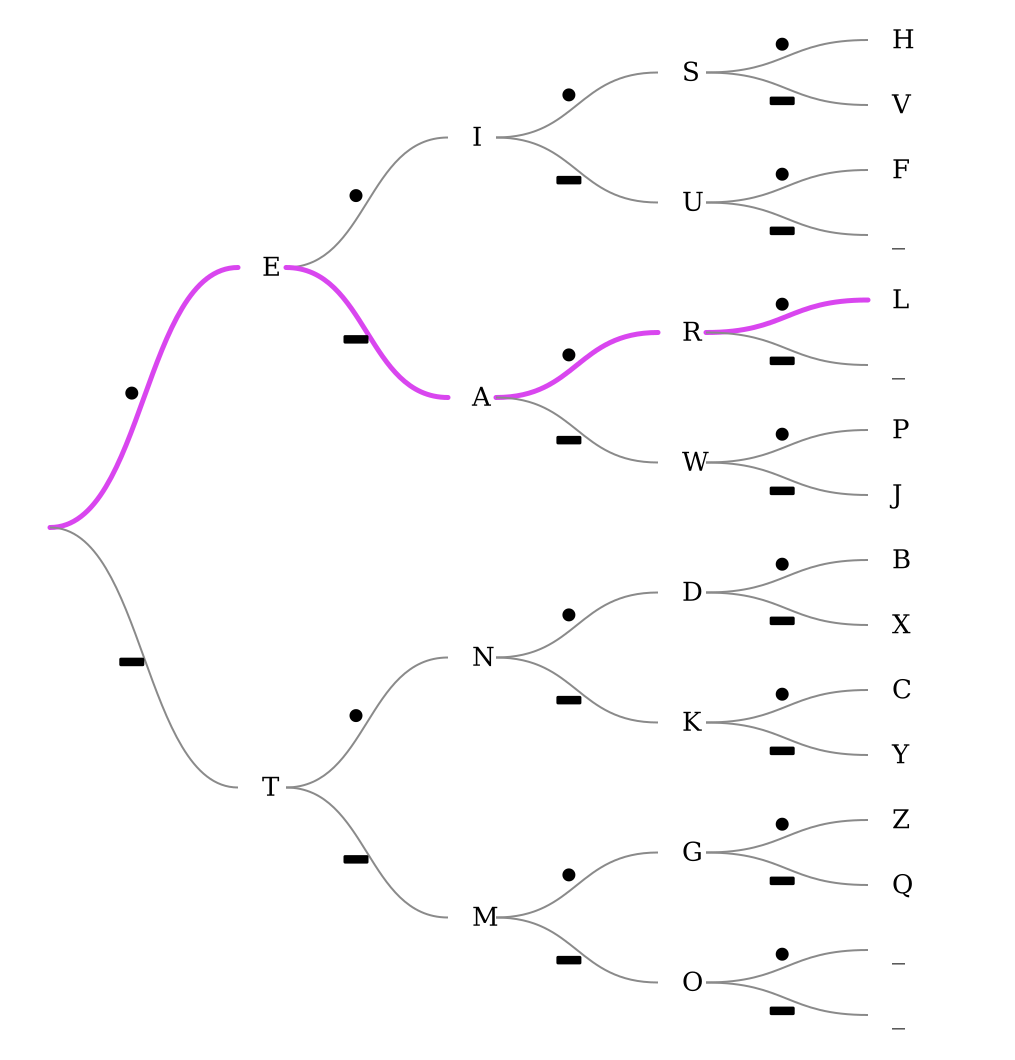
Unlike, previous codes decoding this code is slightly (but not too much :) challenging. The following tree helps in decoding received codewords back to messages, it is essentially the previous table but converted into a tree. once we receive a codeword, we start from the root of the tree at the extreme left and go to above branch for each dot and below branch for each dash; the letter we settle at after the codeword is done is the corresponding symbol of message.
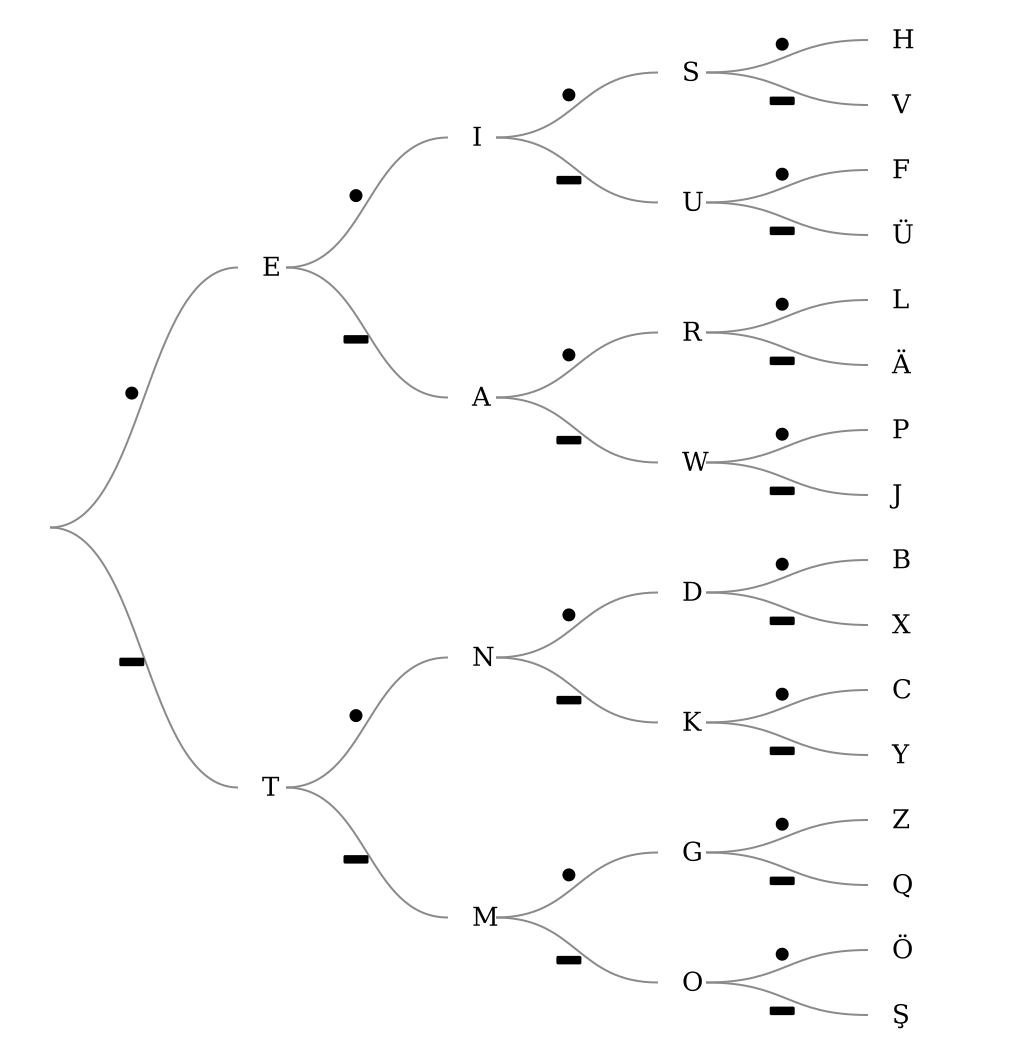
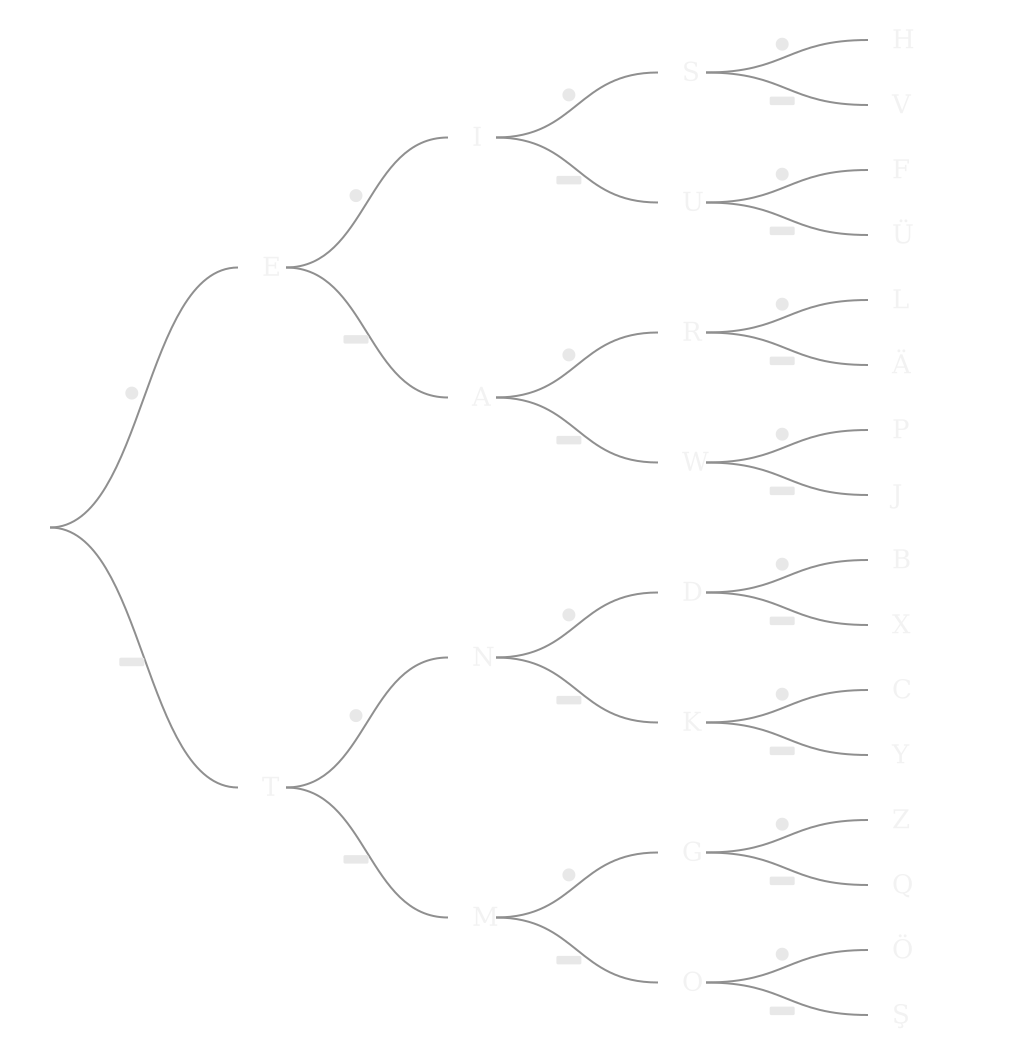 Morse Code Decoding for English letters
Let’s try to decode the text below, I have added appropriate punctuation of length \(1\) dot, \(1\) dash and \(2\) dashes to distinguish between symbols, letters, and words respectively
Firstly, we have $\bullet\,\bullet$, which stands for \(\textrm{I}\), then a punctuation for separating word, then $\bullet-\bullet\,\bullet$, which is \(\textrm{L}\), in this way you will figure out that this message is \(\textrm{I LOVE CODING THEORY}\) and we have now shortened it to \(91\) blinks, another \(33\%\) reduction!
Issues with Morse Code
While, we saw the huge importance of punctuation in our system, it also comes with some caveats.
Punctuation adds delay into our communication, adding to the time spent in sending a message when we do nothing, it would be much better if we could just flash dots and dashes consecutively. This delay is essentially acting as a third symbol (like <space> ) for our codewords. And so, Morse code can’t be used for storing into today’s memories as they strictly support only two symbols (which we denote by \(0\) and \(1\)).
So can we just remove this delay, will our scheme still work?
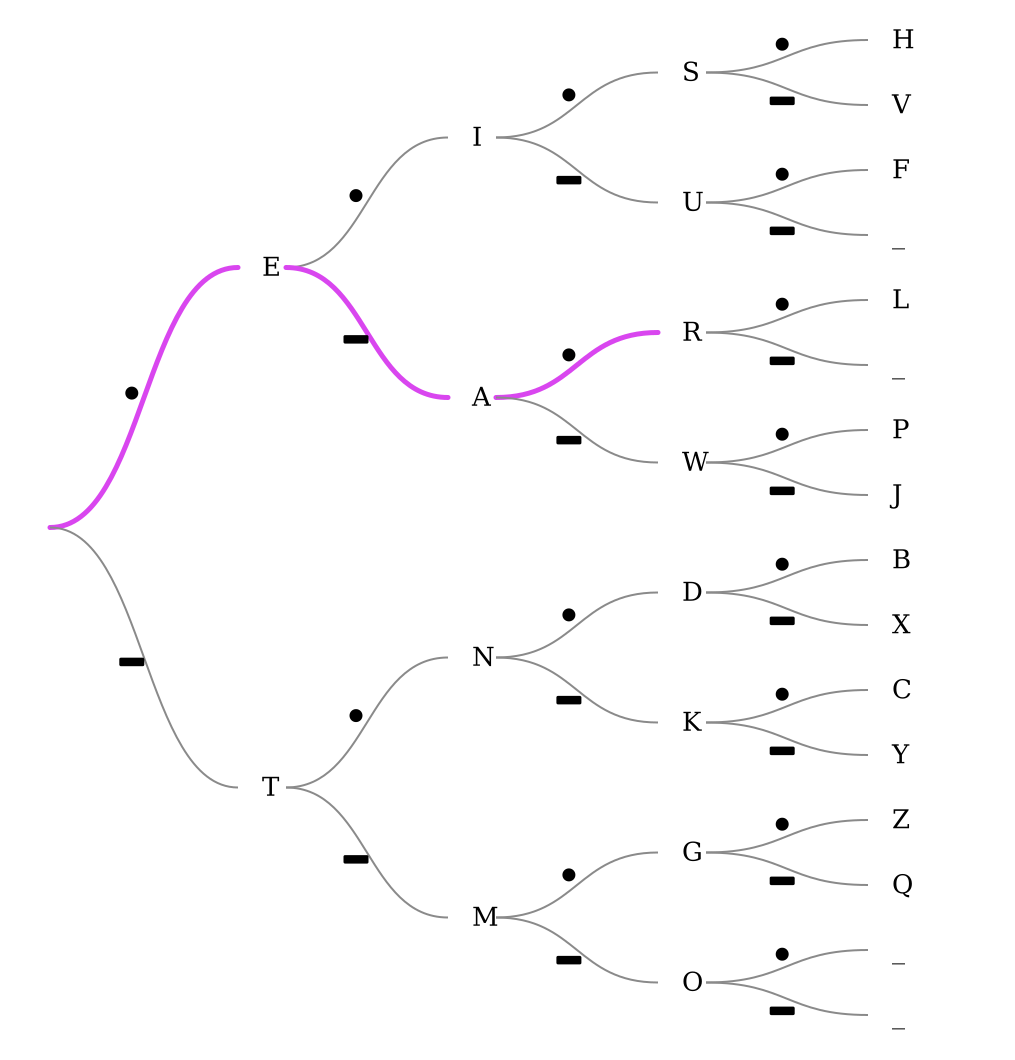
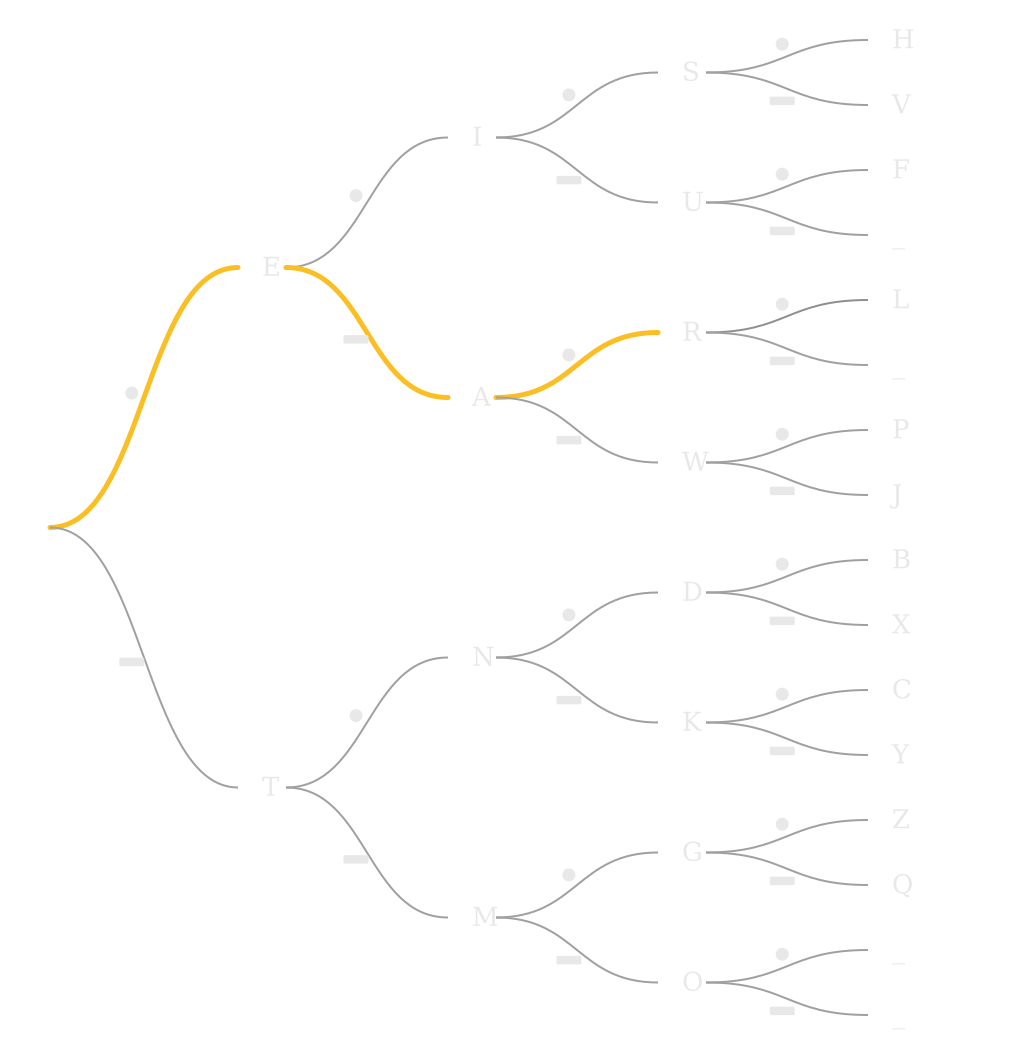 Morse Code Decoding Overlap for Letters
Look at the codewords of \(\textrm{E}\), \(\textrm{A}\), \(\textrm{R}\), they are \(\bullet\), \(\bullet-\), \(\bullet-\bullet\), notice something? Each codeword is a prefix of the following, this means if we receive \(\bullet-\bullet\), we won’t know whether it means \(\textrm{R}\) or if it is \(\textrm{EN}\) or if it is \(\textrm{AE}\), if there was no punctuation. This existence of having prefixes of codewords as some other codeword makes unique decoding impossible.
Potential Solutions
There are two solutions to remove punctuation, let’s look at each of them
Attempt 5 (Fixed-Length Coding)
First is by using a fixed length encoding scheme like ASCII (American Standard Code for Information Interchange), where all letters from \(\textrm{A}\) to \(\textrm{Z}\) are of \(8\) bits (also called a byte) as shown in below table
| Letter | Symbol | Letter | Symbol |
|---|---|---|---|
| \(\textrm{A}\) | \(01000001\) | \(\textrm{N}\) | \(01001110\) |
| \(\textrm{B}\) | \(01000010\) | \(\textrm{O}\) | \(01001111\) |
| \(\textrm{C}\) | \(01000011\) | \(\textrm{P}\) | \(01010000\) |
| \(\textrm{D}\) | \(01000100\) | \(\textrm{Q}\) | \(01010001\) |
| \(\textrm{E}\) | \(01000101\) | \(\textrm{R}\) | \(01010010\) |
| \(\textrm{F}\) | \(01000110\) | \(\textrm{S}\) | \(01010011\) |
| \(\textrm{G}\) | \(01000111\) | \(\textrm{T}\) | \(01010100\) |
| \(\textrm{H}\) | \(01001000\) | \(\textrm{U}\) | \(01010101\) |
| \(\textrm{I}\) | \(01001001\) | \(\textrm{V}\) | \(01010110\) |
| \(\textrm{J}\) | \(01001010\) | \(\textrm{W}\) | \(01010111\) |
| \(\textrm{K}\) | \(01001011\) | \(\textrm{X}\) | \(01011000\) |
| \(\textrm{L}\) | \(01001100\) | \(\textrm{Y}\) | \(01011001\) |
| \(\textrm{M}\) | \(01001101\) | \(\textrm{Z}\) | \(01011010\) |
<space> |
\(00100000\) |
Even a space character has a codeword in ASCII \((00100000)\). So, a message like \(\textrm{I LOVE CODING THEORY}\) which has a total of \(20\) characters (including spaces), gets mapped to exactly \(20\times8=160\) symbols. That’s a lot of symbols yes, but we will see later how this is still an improvement. Decoding the received message is also pretty simple, divide it up into chunks of \(8\) and individually decode each of the codeword to get back the message. Also, below is the decoding tree, look at how simple it looks!
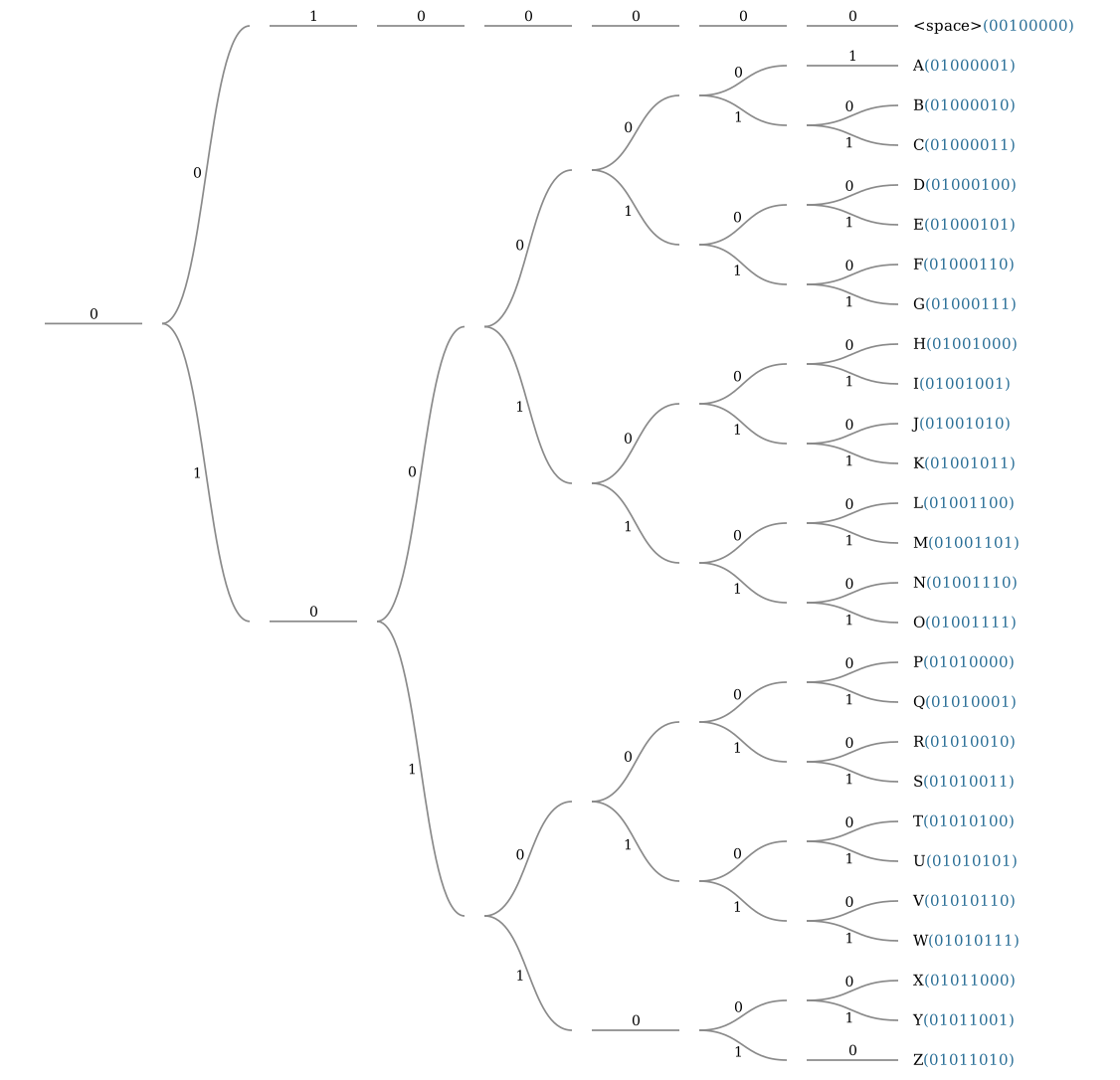
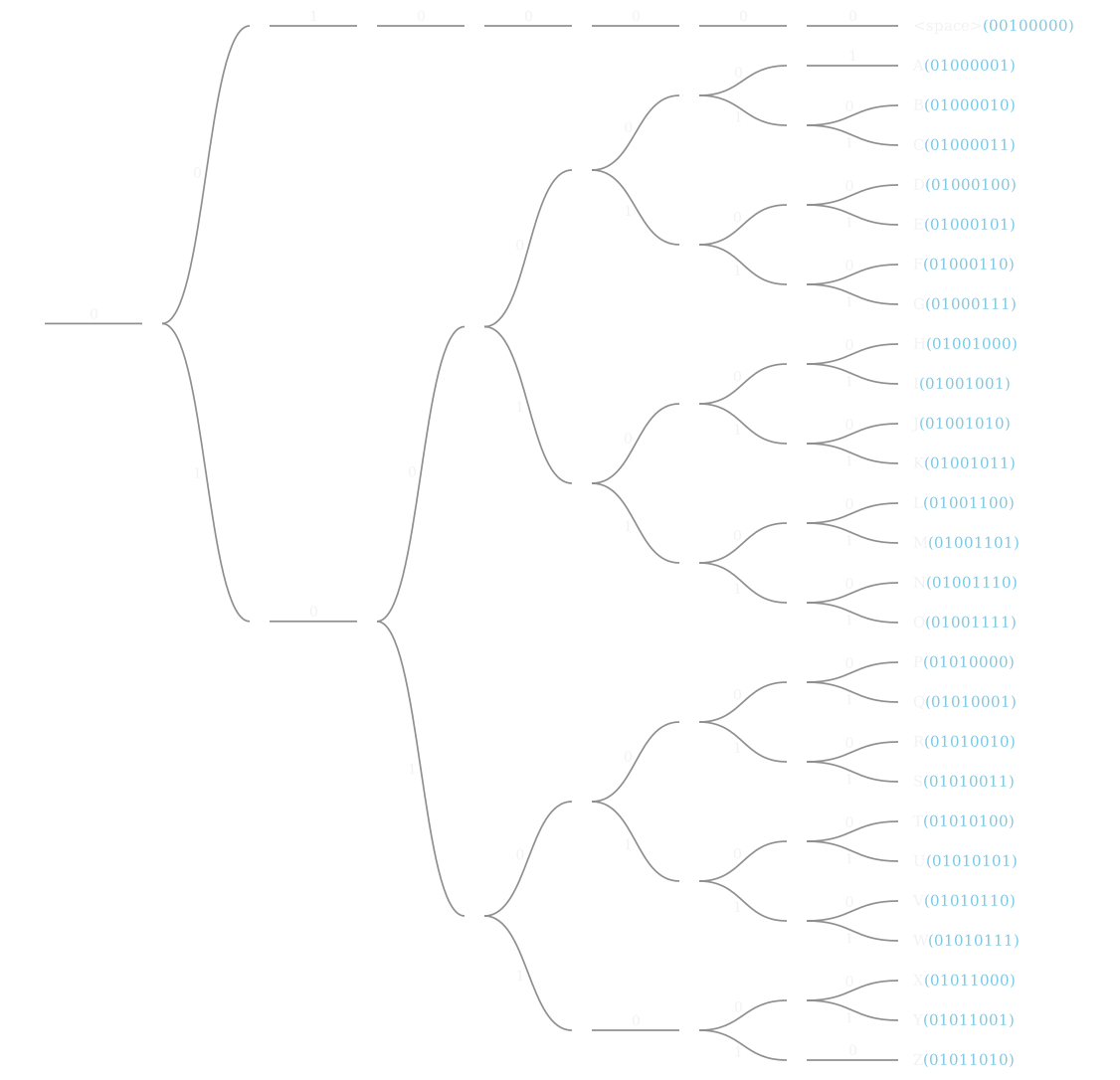 Ascii Code Decoding for English letters
Prefix-Free Coding
Second solution is to only have codewords that are prefix-free, means no codeword should be a prefix of any other codeword. How can we achieve this?
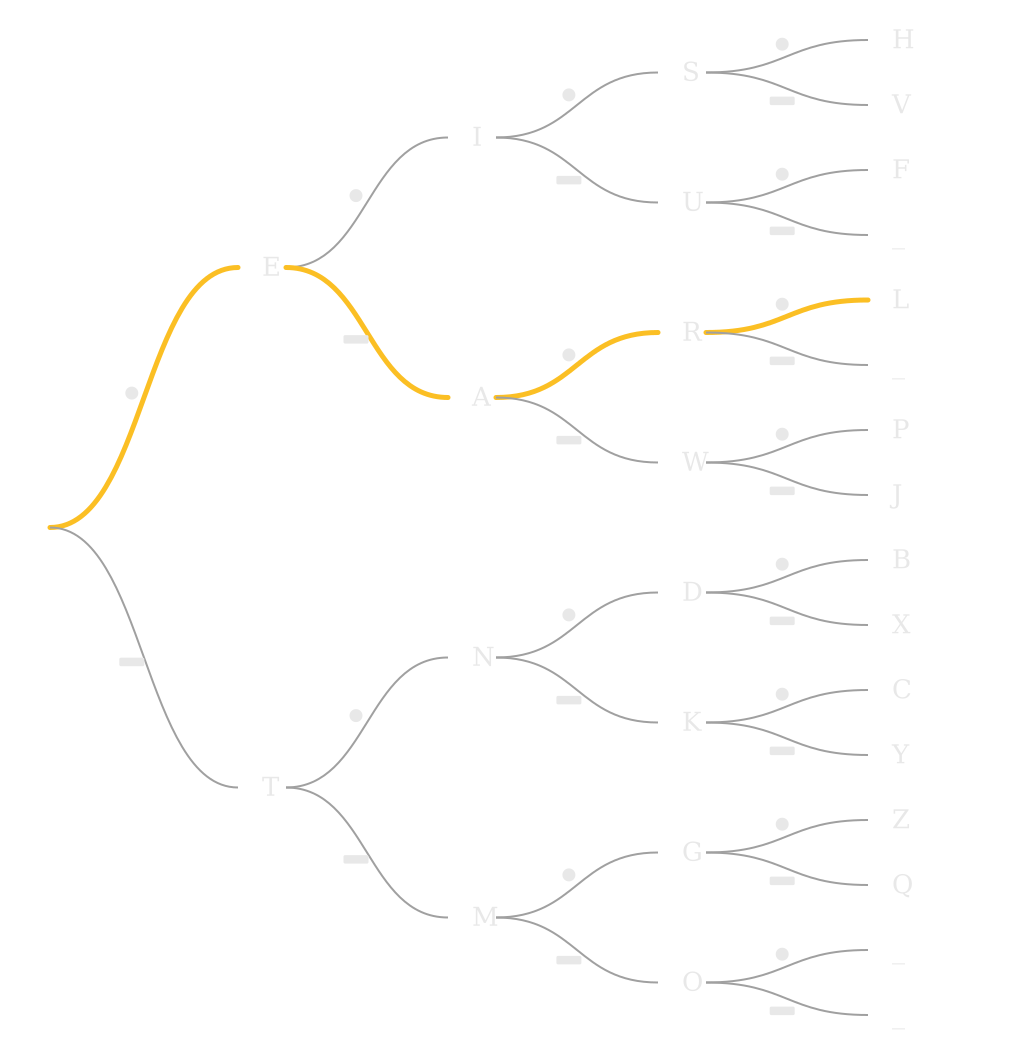 Morse Code Decoding Overlap for Letters
Take a look again at the Morse Code decoding tree, the prefix ambiguity comes if there is any internal node, like \(\textrm{E, A, R}\) are in the middle of the path from the root node to the terminal node \(\textrm{L}\). So, if we assign codewords such that all letters are at the terminal of the tree (also called leaves) then they will be prefix-free.
Everything that we have learnt till now, will be used to explore this next example.
Codes for Storage
Attempt 6 (Huffman Code)
Spoiler alert, Huffman Code is the limit of communication, it’s the optimal way of communicating, you can’t do better than this.
The encoding table and the decoding tree are given below:
| Letter | Symbol | Letter | Symbol |
|---|---|---|---|
| \(\textrm{A}\) | \(1100\) | \(\textrm{N}\) | \(1000\) |
| \(\textrm{B}\) | \(101000\) | \(\textrm{O}\) | \(1011\) |
| \(\textrm{C}\) | \(00001\) | \(\textrm{P}\) | \(101001\) |
| \(\textrm{D}\) | \(11011\) | \(\textrm{Q}\) | \(1111001001\) |
| \(\textrm{E}\) | \(011\) | \(\textrm{R}\) | \(0001\) |
| \(\textrm{F}\) | \(111101\) | \(\textrm{S}\) | \(0101\) |
| \(\textrm{G}\) | \(101011\) | \(\textrm{T}\) | \(1110\) |
| \(\textrm{H}\) | \(0100\) | \(\textrm{U}\) | \(00000\) |
| \(\textrm{I}\) | \(1001\) | \(\textrm{V}\) | \(1111000\) |
| \(\textrm{J}\) | \(1111001010\) | \(\textrm{W}\) | \(111110\) |
| \(\textrm{K}\) | \(11110011\) | \(\textrm{X}\) | \(1111001011\) |
| \(\textrm{L}\) | \(11010\) | \(\textrm{Y}\) | \(101010\) |
| \(\textrm{M}\) | \(111111\) | \(\textrm{Z}\) | \(1111001000\) |
<space> |
\(001\) |
Let’s try an example \(\textrm{I LOVE}\) can be encoded as following from looking up the encoding table \(1001{\color{skyblue}{001}}11010{\color{skyblue}{1011}}1111000{\color{skyblue}{011}}\), note the color difference is just for us to better separate the letters it isn’t actually used in the scheme.
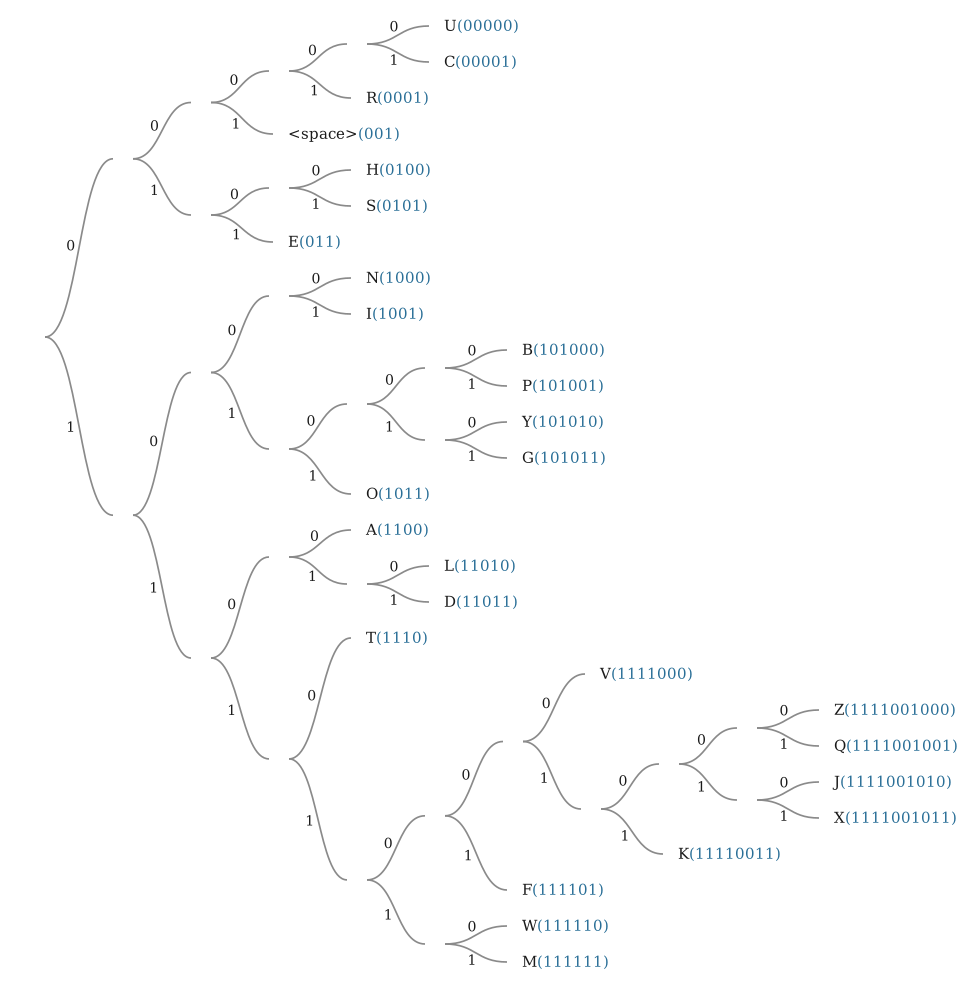
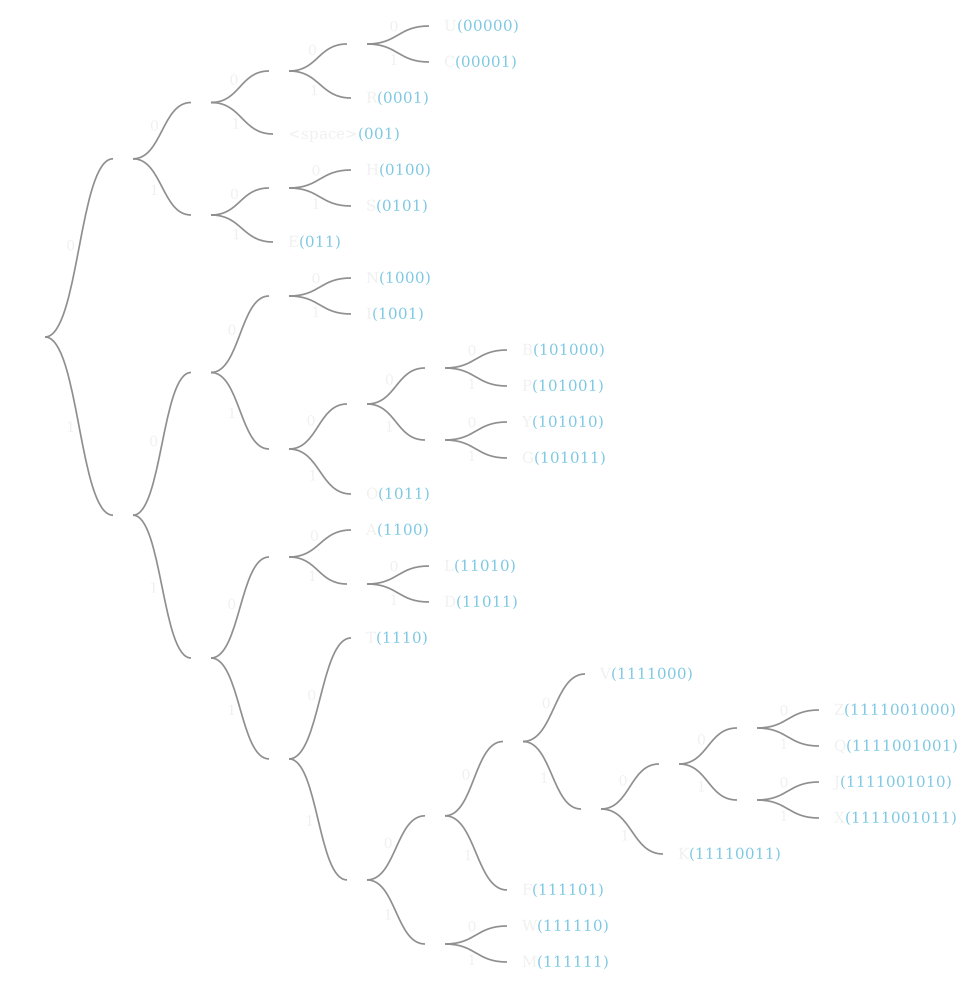 Huffman Code Decoding for English letters (Tree generated using Huffman Coding Calculator by dCode)
Notice, already that there are no symbols at internal nodes implying that this code is prefix-free. Now, to decode our previous message, all we need to is start from the root node, and go up or down the branches appropriately, and as soon as we reach a leaf, we stop, that’s one letter decoded and then we go back to root node and repeat the process. And, it will work!
\(\textrm{I LOVE CODING THEORY}\) in its entirety requires \(85\) symbols which are shown above in their full glory. Before, we compare all our schemes, let’s look at how a Huffman Tree is generated.
Huffman Tree Generation
- Intuition
- Go back to the encoding table and, you will see that the codewords for \(\textrm{E}\) (and
<space>) have the shortest length ($3$) and letters like \(\textrm{Q}\), \(\textrm{Z}\) are the longest ($10$), more than thrice in length compared to the shortest codewords. This hints to our good old frequency analysis. In that analysis, we simply sorted all the frequencies and assigned a Base $1$ codeword based on rankings, which were linear, resulting in least frequent letter getting $26$ times the number of blinks of most frequent letter ($26$ vs $1$). But, now we are working in Base $2$, so we get one more dimension to work with, and the number of combinations explode (like how we got $30$ codewords with only $4$ symbols in Morse). This significantly reduces the maximum possible length compared to our Base \(1\) analysis.
The second (more important) principle on which Huffman based his algorithm was also similar to our previous discussions. Just how less frequent symbols, got more \(\#\)blinks, even in Huffman Tree, less frequent symbols, get codewords of longer length, which ultimately will mean more \(\#\)blinks if used for communication. And so, this tree generation algorithm, always works to find least frequent symbols first to put those at more depth in tree.
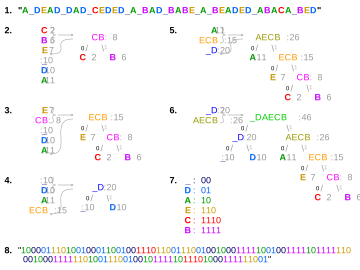
 Huffman Code Generation for a sentence with six characters (Image by Cmglee licensed under CC BY-SA 4.0)
Now, the tree generation process, can be done for any message that you want to send. There are \(3\) simple steps
- (initial step) sort the characters by frequency and put them in a list
- (repetitive step) merge the least frequent characters into a smol tree (partial tree) and reinsert this tree into the sorted list with the frequency equal to sum of frequency of characters that make up this tree
- keep doing the repetitive step until we use all the characters and are left with just one tree, the final tree
Ideally, the generated tree depends on sentence to be shared, and so while communicating every message, its generated tree should also be shared, as it will be needed for decoding. But for the purposes of my example, I constructed a general tree which can be used for all messages. This Huffman tree generation uses each letter with their frequency according to the discussed frequency analysis graph. You can think of this as using a giant book as the “sentence” in the above tree creation process, since the frequencies of characters in a giant book will roughly match with frequency analysis table. So, we don’t need to share this tree, as long as we agree on the frequencies, our tree will be the same, right? Well, there is a little technicality. Let’s look at 4th step in the tree generation image. What if \(\textrm{A}\) also had frequency of \(10\), then we will have a three-way tie between the <space>, \(\textrm{A}\) and \(\textrm{D}\). We can pick any two of them and continue from there. But each such combination will lead to a different tree. So, if we want to generate the same trees every time, we also need to follow same convention to break these ties, one possible example could be always picking up the “earliest” letter pair and giving the highest priority to <space> if it is present. So, as long as we agree on the frequencies and our conventions, our tree will be the same, and we don’t need to send it everything.
Comparison of Schemes
How to even compare all these schemes? To start simply, let’s us look at all encodings together. The length roughly gives us some idea on how good a scheme is. I have replaced the dots and dashes of Morse with \(0\) and \(1\) respectively for easier comparison.
| Attempt | Scheme Name | Encoding of \(\textrm{I LOVE CODING THEORY}\) |
|---|---|---|
| 2 | Blinking a.k.a. Base \(1\) | $111111111\,\,\,111111111111\,111111111111111\,1111111111111111111111\,11111\,\,\,111\,111111111111111\,1111\,111111111\,11111111111111\,1111111\,\,\,11111111111111111111\,11111111\,11111\,111111111111111\,111111111111111111\,1111111111111111111111111$ |
| 3 | Base \(1\) + Frequency Analysis | $11111\,\,\,11111111111\,1111\,111111111111111111111\,1\,\,\,1\,11111111111\,1111\,1111111111\,11111\,111111\,11111111111111111\,\,\,11\,11111111\,1\,1111\,111111111 111111111111111111$ |
| 4 | Morse Code | $0\,0\,\,\,\,\,\,0\,1\,0\,0\,\,\,1\,1\,1\,\,\,0\,0\,0\,1\,\,\,0\,\,\,\,\,\,1\,0\,1\,0\,\,\,1\,1\,1\,\,\,1\,0\,0\,\,\,0\,0\,\,\,1\,0\,\,\,1\,1\,0\,\,\,\,\,\,1\,\,\,0\,0\,0\,0\,\,\,0\,\,\,1\,1\,1\,\,\,0\,1\,0\,\,\,1\,0\,1\,1$ |
| 5 | ASCII | $0100100100100000010011000100111101010110010001010010000001000011010011110100010001001001010011100100011100100000010101000100100001000101010011110101001001011001$ |
| 6 | Huffman Code | $1001001110101011111100001100100001101111011100110001010110011110010001110110001101010$ |
While, Morse looks the shortest, remember that its dash is three times longer than a dot. Whereas, the $0$s and $1$s of ASCII and Huffman can be sent in the same time of one blink. How? That’s the genius of Line Coding, which is added as an appendix for interested folks. Then to compare all these schemes, we can easily calculate the time taken to transmit the message $\textrm{I LOVE CODING THEORY}$ for all the schemes. Let’s formalise this, restricting each blink to mean ON for \(½\) second.
Attempt 2 (Base \(1\))
Here, our encoded message consists of blinks and three levels of pauses as discussed earlier. The time taken by each part is
- Blink: \(½\) second
- Pause
- Within Letters: \(½\) second
- Between Letters: \(1 ½\) second
- Between Words: \(3\) second
We can calculate the total time taken, by calculating time taken by each part independently and summing them together like below
So, the total time taken by our 2nd attempt $t_2$ for any sending any collection of words is given by
Try to pause (pun unintended) and understand how this formula works maybe using our example, I have already split it into parts so that it is easy to derive. A key hint is to first try to calculate the time for a single letter, then a single word and then finally a collection of words, if you are able to correctly solve for single letter, you have already completed halt the job, the last half is just about recognising the pattern and using it for next calculations.
Now, getting the value for the message $\textrm{I LOVE CODING THEORY}$ is a matter of trivial substitution into this formula.
Attempt 3 (Base \(1\) + Frequency Analysis)
Notice, the structure of our encoded message in this and previous attempt is the same (Base \(1\)). The only difference between this and previous attempt is that now, \(\#\)blinks for every letter is according to their frequency, so the total time spent blinking (\(\#\)blinks) may change, but rest of our analysis, will still work, as a result, the same formula works!
Now, let’s try substituting values into it
Attempt 4 (Morse Code)
Even, this analysis is similar, let’s breakdown a message encoded using Morse and the time taken by each part
- Dot: \(½\) second (same as Blink)
- Dash: \(1½\) second (3 Dots)
- Pause
- Within Letters: \(½\) second (Dot)
- Between Letters: \(1 ½\) second (Dash)
- Between Words: \(3\) second (2 Dash)
Now, can you write down the formula just by using previous formulae? Think about it! All we did while thinking about this Base \(2\) method was adding another symbol (dash) to our Base \(1\)’s blink (dot). So, only \(\#\)blinks part in the formula needs updation and there we have it
Notice, the ‘time spent blinking’ and ‘pause within letters’, have different multiplication factors to \(\#\)dashes, this is because a dash blinks for longer time than a dot, but the time between two dashes or dots is the same (dot). So, the two \(\#\)blinks terms in our previous formula were used for different purposes, which is why I had kept the formula as it is instead of simplifying it further, which can later cause confusion, if we tried generalising that formula. So, the time taken is…
Attempt 5 (ASCII)
Now, for our remaining attempts, remember that we don’t have any pauses, so we can take $0$ as not blinking, and $1$ as blinking. This will work for us, though there are better ways to do this and we will discuss them later. So, for both ASCII and Huffman, we can simply write the time taken as
\[\begin{align}{\label{eq:nopauses}} t_{5 || 6} &= \text{#0s}\cdot½ + \text{#1s}\cdot½ \end{align}\]Now for ASCII, this means
Substituting numbers, we get
\[\begin{align*} t_5 &= 4\cdot(17 + 4- 1)\\ t_5 &= 80\, \text{seconds} \end{align*}\]Attempt 6 (Huffman Code)
Here, we use equation $\ref{eq:nopauses}$ directly, since every character can have variable number of \(\#0\)s and \(\#1\)s, so it’s better to count all of them and calculate the answer
\[\begin{align*} t_6 &= (\underbrace{40}_{\text{#0s}} + \underbrace{45}_{\text{#1s}} ) \cdot½\\ t_6 &= 42.5\, \text{seconds} \end{align*}\]So, the final numbers turns out to be as shown below.
| Attempt | Scheme Name | Time Taken (in seconds) to transmit $\textrm{I LOVE CODING THEORY}$ | |
|---|---|---|---|
| 2 | Base \(1\) | $226$ | |
| 3 | Base \(1\) + Frequency Analysis | $158$ | |
| 4 | Morse Code | $89$ | |
| 5 | ASCII | $80$ | |
| 6 | Huffman Code | $42.5$ |
$42.5$ seconds is just a fifth of the time to transmit ‘our message’ compared to our initial naive attempt \(\#\)2 of blinking a flashlight. Well done!
The Limits of Compression
You might question the authenticity of our analysis, what happens if the message changes? Is Huffman still the best? and by how much?
You might wonder if we can do better than Huffman Code, if it is possible to keep reducing the time taken forever.
These are all valid questions, firstly I encourage everyone to work out the timings for other sentences, and secondly, it is also possible to do a probabilistic analysis (using our good old frequency tables) and find out the average performance of each schemes. I leave this exercise to you :)
Now, coming to the big results Huffman Code is the limit!. Yup, you can’t really do better than it. Do check out this awesome video2, which dives into Information Theory. Essentially, the idea is to mathematically calculate the information content within our message, and prove that Huffman Code either matches it or comes as close as possible for a code.
Another doubt could be, why not use Base \(3\) or \(4\) or higher? after all, we just witnessed these wild improvements from Base \(1\) to \(2\). Let’s go back to our setup, what Base \(2\) really meant was their were $2$ states that our flashlight could be: either OFF or ON. But modern flashlight comes with brightness levels, as long as you and your friend are able to distinguish these brightness levels, go ahead and experiment! Things will definitely be easier, after all in Base \(27\) (alphabets+space), our message \(\textrm{I LOVE CODING THEORY}\) is just $20$ characters, so it will take just $10$ seconds to transfer it using a flashlight with at least $26$ different brightness levels (and an OFF state). So, the time taken to send the message definitely reduces with more symbols. You can even try creating a $n$-ary Huffman Tree with $n$ children at each node compared to the $2$ children for Base \(2\) case, it will still work with some catch. So, how is our original Huffman Code optimal? It is optimal not in terms of time taken or length but in terms of compression. And compression is about storage. It’s about storing a particular piece of information in a digital computer using minimum amount of resources possible. Since, our computers use bits, which are either $0$ or $1$, a $2$-ary Huffman Tree utilises the computer’s resources optimally with minimum wastage. Even if we use say, $4$ symbols, and compute our optimal codewords using $4$-ary Huffman Tree, ultimately each of these $4$ symbols will need to be converted to a binary number needing $2$ symbols ($00$, $01$, $10$, $11$) so that our computers can process it. But, after everything is converted to $2$ symbols, the resultant codewords of a $2$-ary Huffman Tree are optimal, and its codewords are not necessarily the same as the codewords generated from the $4$-ary Huffman Tree, which will be all even length in base $2$.
Future computing developments may change our the foundational unit of computation from something other than bits, but we don’t need to look into the future, instead look into the nature, look at the DNA, the instruction manual of our body, which stores our entire genome, it is built from \(4\) chemical bases Adenine (A), Thymine (T), Cytosine (C) and Guanine (G). Isn’t this fascinating?
Conclusion?
And with that, we have reached what I would call as a significant point of our journey. Congrats! You made it till here. You have my thanks for reading this blog and I hope you will keep enjoying it. Before we start again, now is the best time to sit back, and think of what we have accomplished. Recollect our progression, how we started from Blinking, Frequency Analysis, Morse-code, ASCII and made our way up till Huffman and think, are we done here? After all, we even saw the optimal Huffman Code, so what’s left? Come back once you have thought about this again.
Issues with Huffman Code
Fixed Alphabet
While, my home grown Huffman Code tree will work for our English alphabet and the <space> characters, what if one day we decided to add more details into our messages by using punctuation marks‽ or you try to practice new language that you have recently started learning, and send its characters (good luck going through 100,000 Kanji characters :), can you talk about your math homework without numbers or math symbols ∅
Currently, our system is fixed, we think about frequencies, make a tree and call it a day. So, how can we make our system dynamic, where we can continuously keep adding stuff. The answer is 🥁… Unicode! One of the most incredible man-made inventions, which is what the entire modern web is built around. All the text on this and other website (including the emojis and math-equations) is represented by it. Unicode is THE standard way of exchanging text within computers. You might have come directly across the term UTF-8, when trying to save .txt files or indirectly wͮͮ̒h̴̠͉̿͆ͧe̵̍̍̿ñ̜͊ y͉̳̅o͔̙̫u̦̣͗̇̂ r̮̱̅ͥe̵͉͆c̴ͤe̴͍͓i͒̇v̜̦̌e̷͕͎̩̔ͭͧd̴ an English message that seemed corrupted3. But if you are wondering wtf is UTF-8, essentially, it is the culmination of things that we have learnt today, an encoding method used all across the world.
- It is a variable length encoding scheme where the codeword is in $1$-$4$ chunks of a byte (i.e., $8$ bits), meaning the total length varies from $8$ to $16$/$24$/$32$ bits.
- All the $8$ bit codewords correspond to ASCII, the ‘most popular’ language on the internet.
- It is also a prefix-free code, as no codeword can be a prefix of another. This can be visually seen from the below diagram as the start of all the codewords of different length is different.
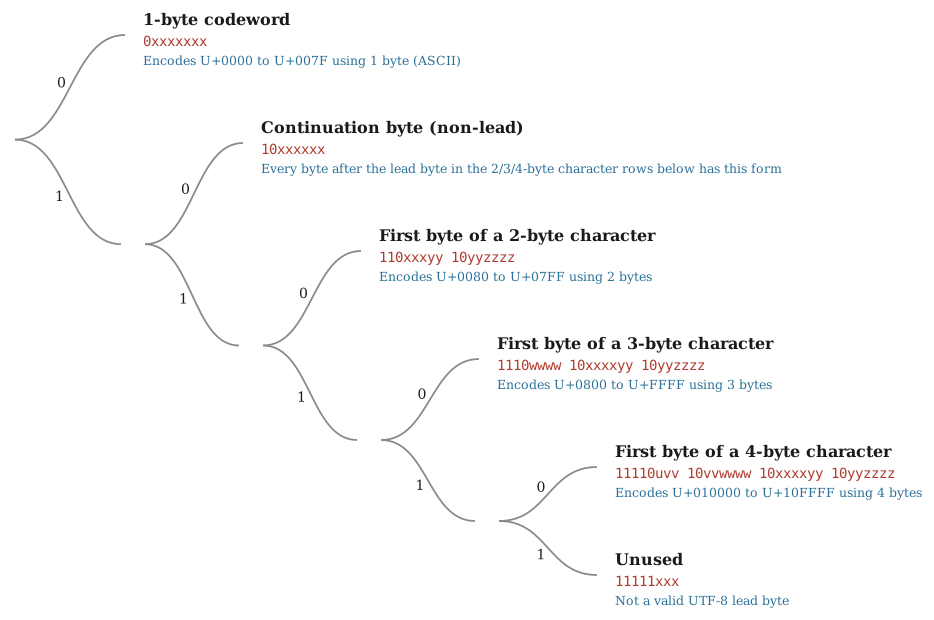
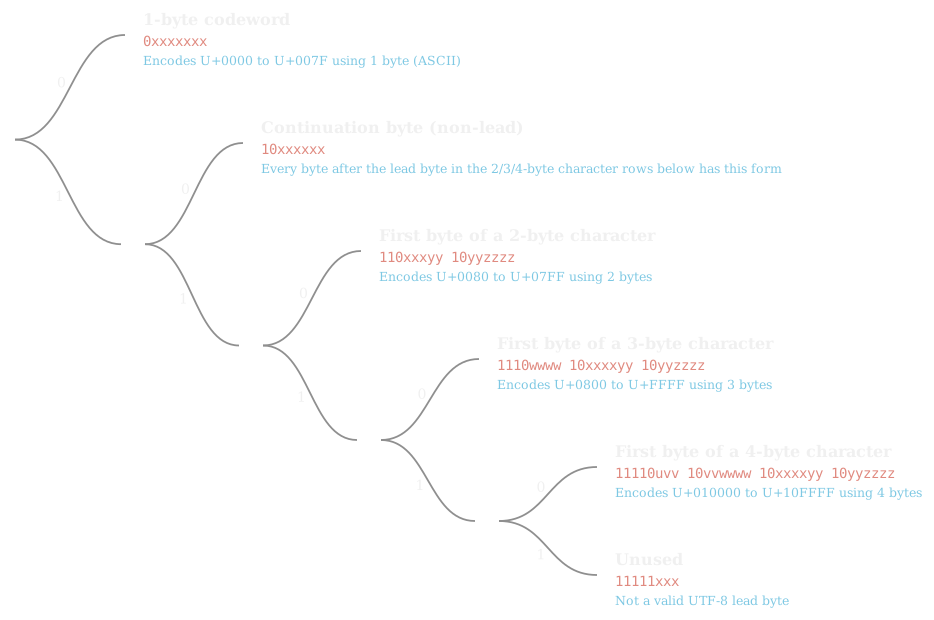 UTF-8 Encoding in a Nutshell
I can go through a few examples and there are more things to say here, but I am intentionally keeping this section short, so that if you are curious you can check it out yourself4, there’s even a Tom Scott video5 on this.
UTF-8 can represent roughly a million characters, so you get a lot of characters but the alphabet is still fixed. Our issue isn’t technically solved. Yes, we haven’t used most of the characters yet, thanks to zero-width joiners, so as of now it is ok.
Errors
Would you believe me if I said we missed a very important point in our analysis? This might start to feel annoying unless you thought it about during your break-time. What if while sending message, your friend makes an error? Say they themselves blinked while you were blinking your flashlight and hence misinterpreted a $1$ as $0$. Will this have any impact on your message.
Well, let’s go through our codes again, and try to decode our original message but here the seventh bit has is mistaken as $0$ instead of $1$.
Huffman Code Decoding for English letters
Decoding it using the Huffman tree, we get the message as $\text{I}{\color{orangered}\text{RYMCI}}\text{CODING THEORY}$, and we lost out on $\textrm{LOVE}$ 😭. So, if even one bit was actually misinterpreted then it can corrupt future codewords and there is no way to recover them other than guessing. Will this big impact happen with ASCII and Morse too, what do you think?
As ASCII is fixed-length, if just one bit was corrupted then it will only have an effect on the $8$ bits that contain it, so max one character will be different. So, if we had received
then it gets decoded as ${\color{orangered}\text{K}}\text{ LOVE CODING THEORY}$.
And, for Morse
we get, ($\text{I L}{\color{orangered}\text{W}}\text{VE CODING THEORY}$), even though Morse is variable length like Huffman, it worked out thanks to its pauses. Of course, this is an artificial example of flipping the seventh bit for some reason, but the lesson is while we do get ultimate compression using Huffman Code, we lose out on its error-correction capabilities. This makes intuitive sense too, as Huffman was able to compress well because it removed any sort of redundant information from it.
Types of Coding
Till now, we studied about Source Coding, which was all about encoding and data compression, though in particular, we explored concepts of lossless compression, that makes it possible to perfectly reconstruct our message from our encoded message. Another important branch of Coding Theory is Channel Coding which goes deep into this analysis of possible errors (like noise) during communication and uses codes to add redundancy instead for reliable (error-resistant) communication.
Think of another possibility, this time you want to communicate about your love (of coding theory of course) in secret, so that no one apart from your friend is able to understand the message. This is the problem of Cryptographic Coding, which is about secure communication. With channel coding, ideally we want to be able to decode our encoded message in any case, even in presence of lot of noise (e.g., bit-flips), but in cryptography, we only want the intended receivers to be able to decode decrypt our encoded message ciphertext and to other observers our message should be nothing but random noise, since if it had any patterns, those patterns can be used to get back the original message.
This leaves us with the last type, which will be discussed now!
Appendix: Line Coding
Remember that I made this point that the $0$s and $1$s of ASCII and Huffman can be sent in the same time of one blink (\(½\) second). Line Coding helps to represent our binary data of $0$s and $1$s into physical (real-world) data. Generally, voltages (either HIGH or LOW) do this task, but in our example, we are using flashlights :)
So the way it is done, is pretty intuitive, we are past blinking now (or are we?). We just need to keep our flashlight ON if we want to send $1$ for \(½\) second and then OFF for $0$. And, we are done with our full text in $42.5$ seconds.
Feel free, to skip this section as it is more of a rambling than an explanation.
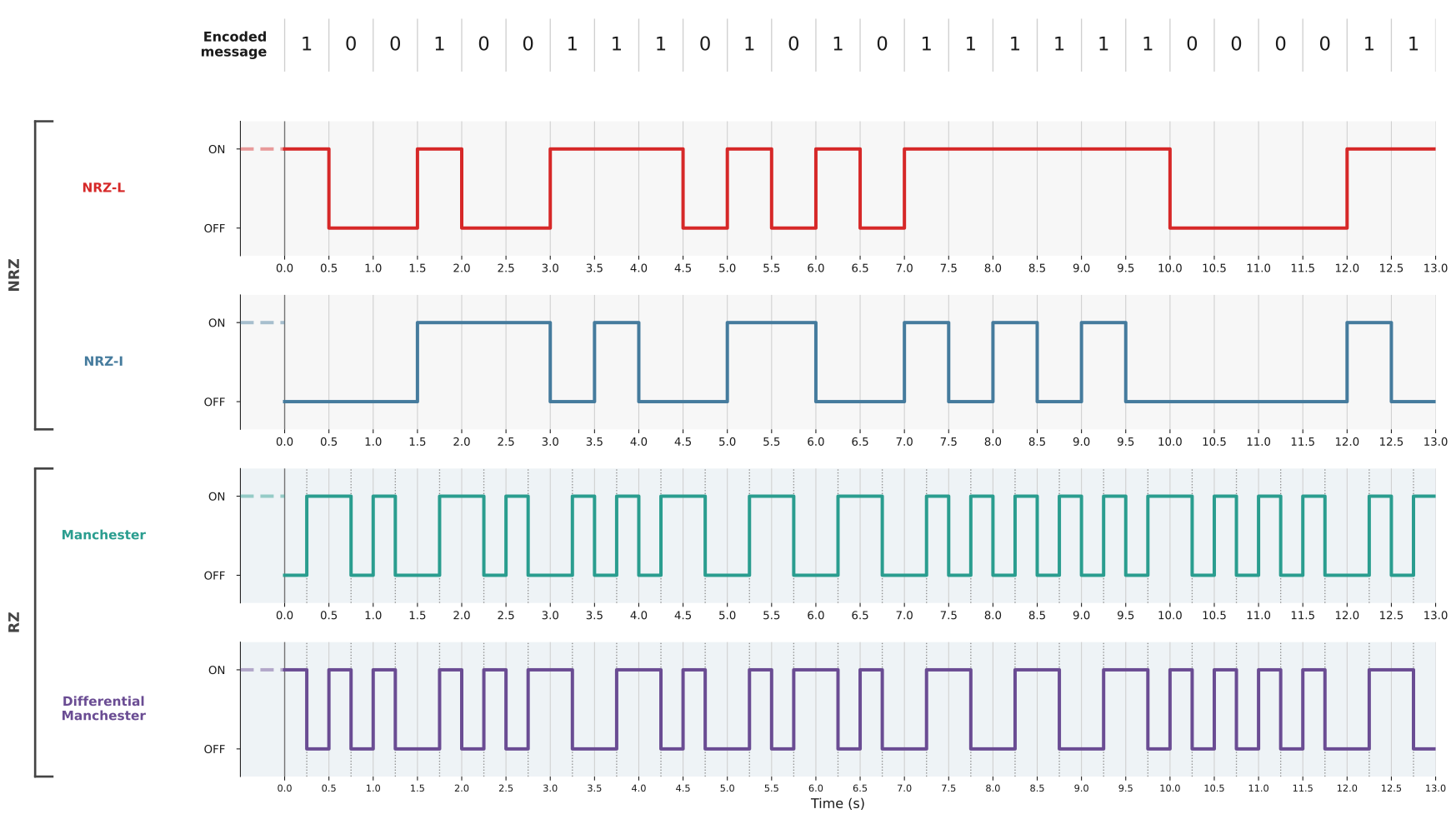
Let’s dive a bit deeper, look at the first plot of below figure. Here, our message $\textrm{I LOVE}$ is encoded using Huffman Code ($26$ symbols sent in $13$ seconds). This simple scheme has a simple name: On–off keying and a mouthful name: Non-Return-to-Zero Level (NRZ-L), which will (hopefully) make sense after looking at other schemes.
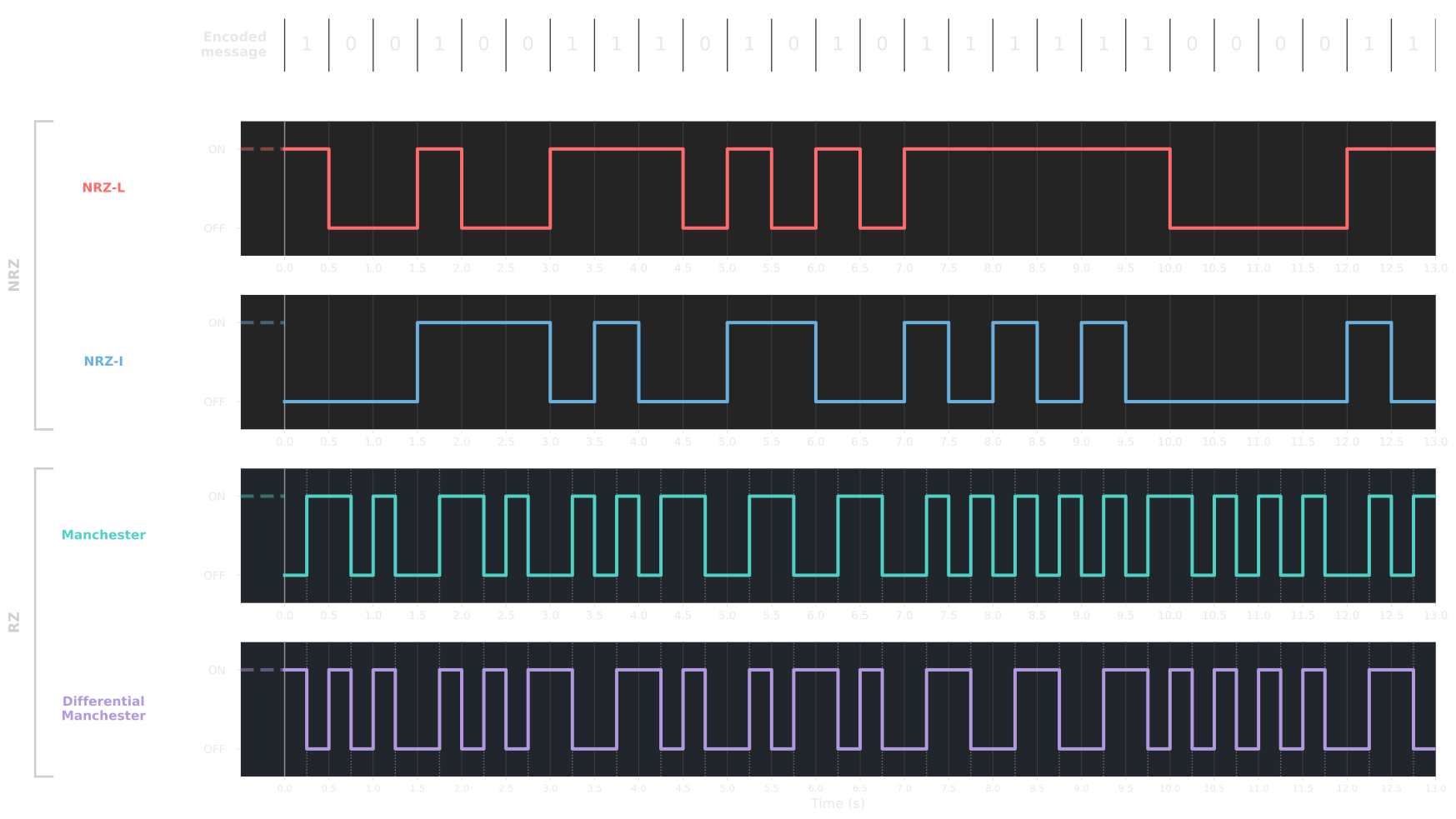 Line Coding Schemes (Timing Diagrams)
Again, let’s think about its issues (the diagram will help). Notice, how there are $6$ consecutive ones from bit $15$ to $20$ ($7$ to $10$ seconds). That means, our flashlight will be ON for $6\cdot½=3$ seconds. The longer the time, the difficult it becomes for humans to keep measuring it accurately, which makes it possible to misinterpret $6$ ones as $5$ or $7$ ones. The technical term for it is clock synchronisation, where we want both the sender and receiver to have the same perception of a $½$ second. So, it’s preferable to have more toggles (switches from $0$ to $1$ or vice versa) to minimise this error in perception.
Let’s try to solve this. How about we toggle our flashlight every time we need to send a $1$? Then even if we have a string of $1$s, our flashlight will keep toggling and thus we won’t need to measure time for long, but wait, in this case, we can’t toggle when we need to send $0$, otherwise, there will be no difference between the behaviour across bits, and subsequently, no distinguishability for the person observing our flashlight. So, when we need to send $0$, we do nothing, and don’t change the flashlight’s state. This is the Non-Return-to-Zero Inverted (NRZ-I) scheme. Sadly, as evident from the timing diagram; this scheme doesn’t work as it won’t toggle if the encoded message is continuously $0$. There is also some trouble when data alternates between $0$s or $1$s as it will either give two consecutive HIGHs or LOWs; this is probably fine, since it means we are HIGH/LOW for at most $1$ second. But, this scheme does do something interesting, now we don’t need to know whether flashlight ON means $0$ or $1$, since what matters is the switching of flashlights, so even if the output is reverse of what we are sending now it will still work for all bits except first bit. This case is not possible for our flashlight communication, but it is easily possible in electrical wires where they can get twisted (like USBs) and affect the direction of voltage. To appreciate it, we can think of a flashlight which is always ON but supports two colours, don’t you think now it will be difficult to remember, which colour is $0$ and which one is $1$? With NRZ-I, we don’t need to.
Just as a convention, we start by keeping the flashlight ON for some time, this helps in determining the first bit for few schemes like NRZ-I.
Both of the above schemes had large sections of constant behaviour, which will lead to synchronisation issues. So, what if we added toggles every time we send data? Say, if we are sending $1$, then we will turn the flashlight OFF for first half of time and turn it ON for next half (then the output will go from low to high) and the opposite for sending $0$ (ON then OFF). Since, now, we will at zero for the half the time, these types of scheme are called Return-to-Zero coding.
This specific scheme is Manchester encoding scheme and the diagram speaks for itself. Now, a toggle is guaranteed to happen for every sent bit at the middle of encoded data (odd multiples of $0.25$ seconds).
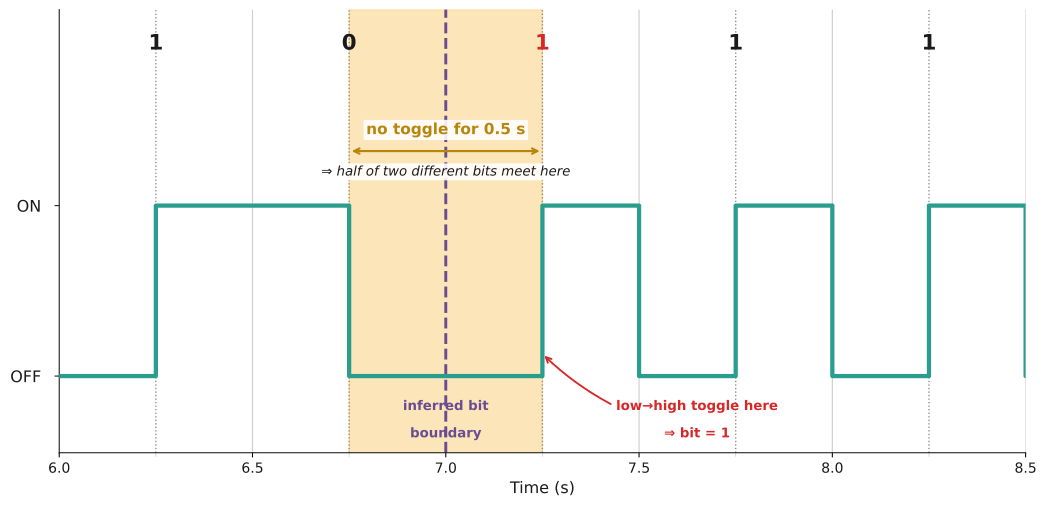
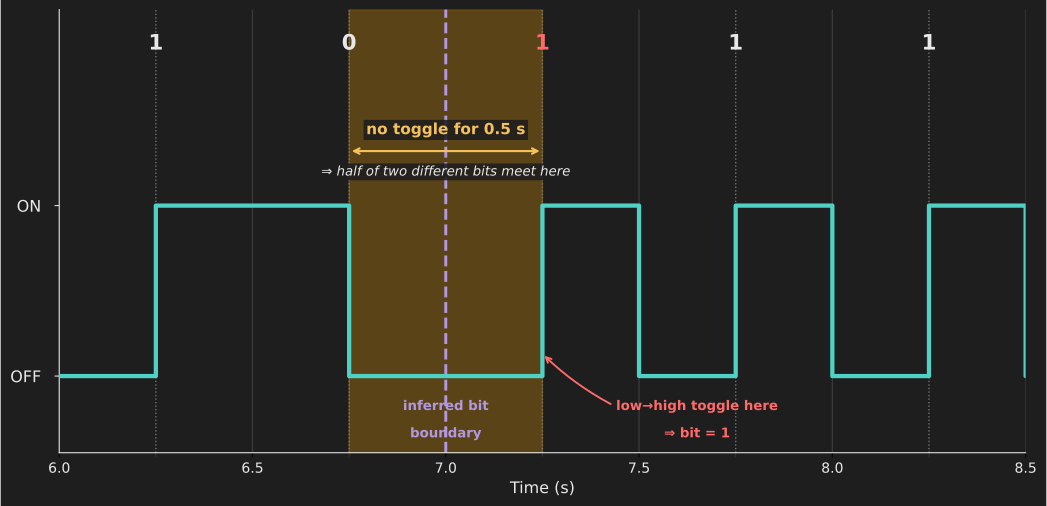 Decoding data encoded using Manchester scheme (Timing Diagram)
The Manchester data decoding is obvious if you look at any part with alternating bits, as they will have a one second window with no toggles inside them. Say if we are only looking at the output data, then we will observe no toggle from $6.75$ to $7.25$ seconds. Now, we need to look at the timing behaviour at $t=7.25$ seconds, and that gives you the toggle associated with going from low to high, so from $7$ to $7.5$ seconds, the output is $1$ and then once we find a bit, it is easy to follow it and get all other bits. Manchester encoding was used for classic Ethernet (1980s stuff).
Okay, so what’s with the last one? It is a mixture of NRZ-I and Manchester called Differential Manchester, taking the best of the both worlds, it has the toggles, and flipping the outputs won’t affect the decoding either. Figuring out how this works, will be an engaging exercise :)
For the RZ encoding schemes, I have reduced minimum toggling time from \(½\) to \(¼\) seconds, so that all the plots line up, but for a fair comparison, I should have kept the minimum time same, which would have meant, the RZ schemes ($85$ seconds) would take twice the time compared to NRZ schemes ($42.5$ seconds) and very close to Morse Code ($89$ seconds). With simple NRZ-L like encoding in Morse (pause can be: $0/000/000000$, dot: $1$ and dash: $111$), thanks to its pauses, there is an inbuilt limit to how long a sequence of $0$s or $1$s can be: $6$ zeroes ($3$ seconds when two dashes separate words) and $3$ ones ($1.5$ seconds for sending dash).
So, Morse Code in some sense was pretty close to being optimal among the cases which avoids clock synchronisation issues, or was it? Well, the hint is in bandwidth which is calculated as information sent per time. RZ encoding halved our bandwidth from NRZ schemes, since we could only send half the data in the same time $(½=50%)$. What if, we create a new scheme, which leverages this bandwidth more optimally, i.e., it reduces our bandwidth but ensures we don’t get many consecutive $0$s or $1$s. This is the 4B5B scheme6, which maps every $4$ bits to a fixed $5$-bit codeword ensuring we never get three consecutive $0$s. So, if we use our NRZ-I encoding with 4B5B for this new set of symbols, then both consecutive $1$s and $0$s are taken care of. Since we use $5$ bits for every $4$ bits, this does mean our bandwidth reduces by $20\%$ (as $⅘=80\%$) compared to traditional NRZ schemes but we gain on clock synchronisation. This scheme was used for fast Ethernet (1990s stuff).
Below, is the 4B5B mapping table, notice that the only way we get three consecutive $0$s is by using a codeword ending in two $0$s with a codeword starting with a $0$, since all the codewords contain at most two consecutive $0$s.
| Letter | Symbol | Letter | Symbol |
|---|---|---|---|
| \(0000\) | \(11110\) | \(1000\) | \(10010\) |
| \(0001\) | \(01001\) | \(1001\) | \(10011\) |
| \(0010\) | \(10100\) | \(1010\) | \(10110\) |
| \(0011\) | \(10101\) | \(1011\) | \(10111\) |
| \(0100\) | \(01010\) | \(1100\) | \(11010\) |
| \(0101\) | \(01011\) | \(1101\) | \(11011\) |
| \(0110\) | \(01110\) | \(1110\) | \(11100\) |
| \(0111\) | \(01111\) | \(1111\) | \(11101\) |
Now, we are forced to club our initial binary data in $4$ bits, there is no codeword for $1$-bit message; so our message with $85$ symbols will need additional $3$ symbols at the end to get divided into nice and round chunks of $4$-bit messages. We can achieve this by adding an extra <space> at the end of our message which is exactly $3$ symbols ($001$). So, finally our message takes $55$ seconds $\left(=(\frac{85+3}{⅘})\cdot ½ \text{ seconds}\right)$. Here’s how all our line coding schemes will fare for the same message $\textrm{I LOVE}$ (encoded using Huffman Code) with accurate timings:
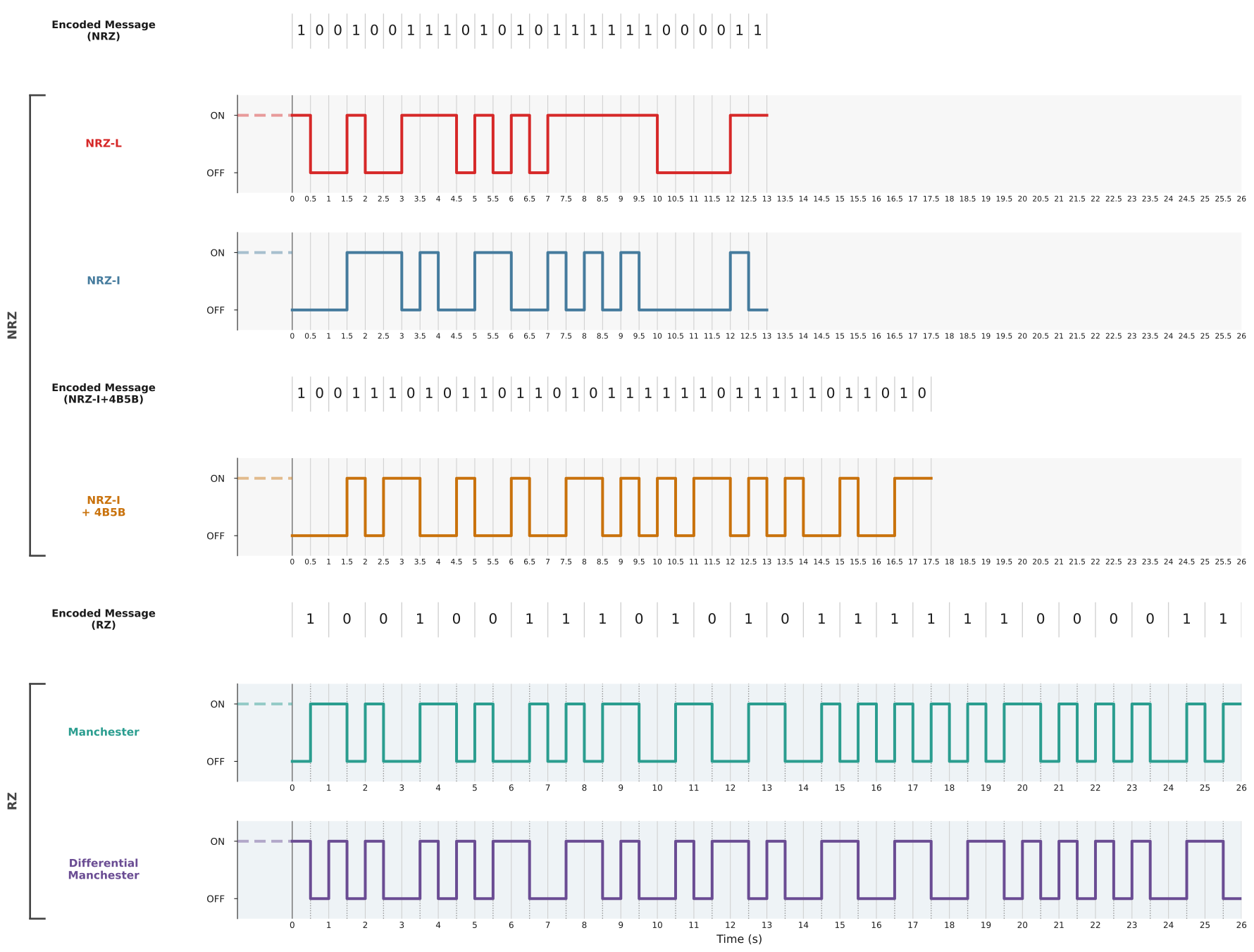
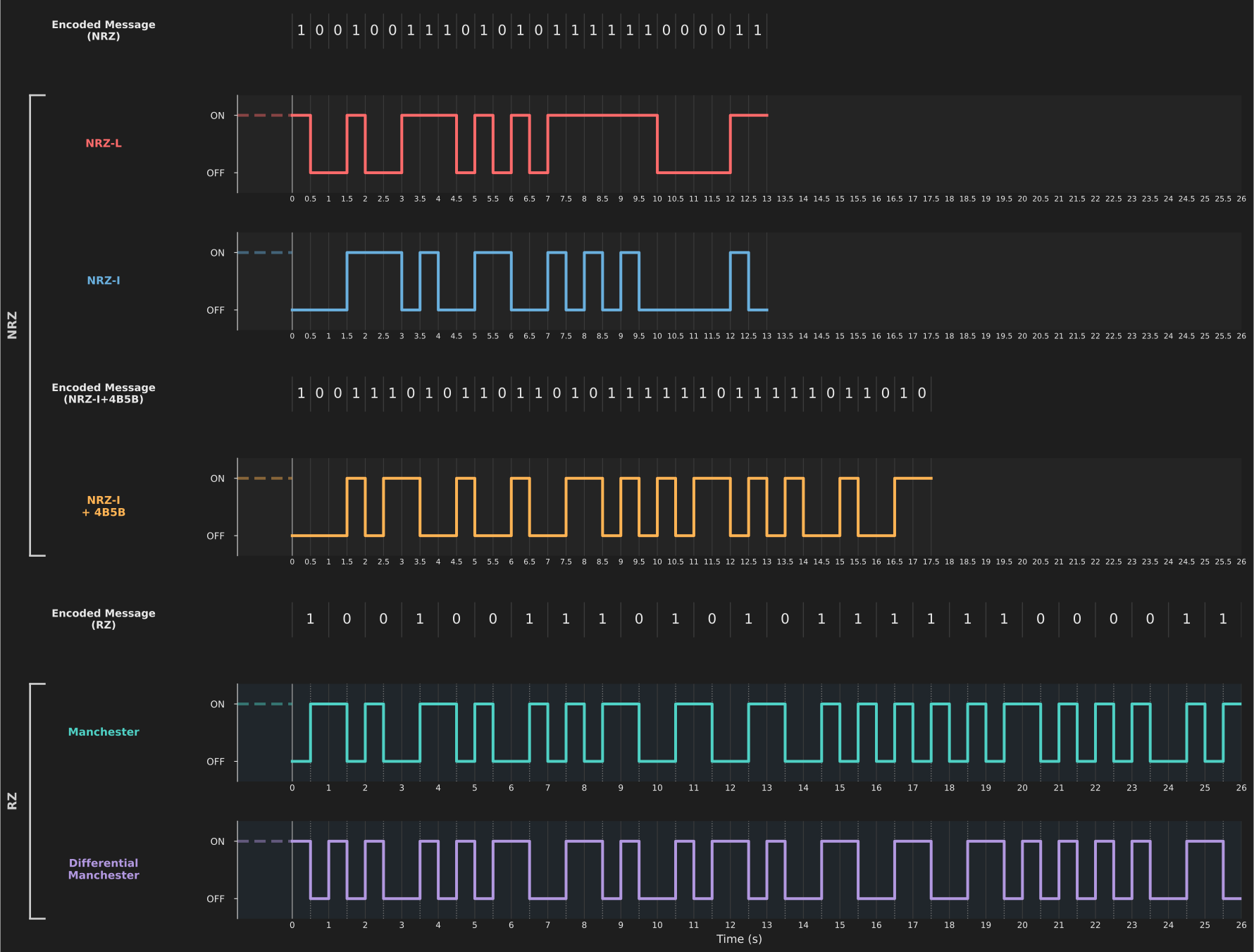 Line Coding Schemes (Realistic Timing Diagrams)
Focus on toggles! Everything is visually clear, we have similar toggles as RZ schemes but didn’t lose too much on bandwidth benefit of NRZ schemes.
Since the 4B5B mapping only uses $16$ $5$-bit codewords, this leaves us with an additional $16$ codewords that our unused, which we can use to make our scheme even more robust, like using $11001$ and $11000$ to denote the start and end of our message respectively. Finally with this extra features, we are able to send our message in $60$ seconds, here’s how your flashlight will look when you send \(\textrm{I LOVE CODING THEORY}\) :D
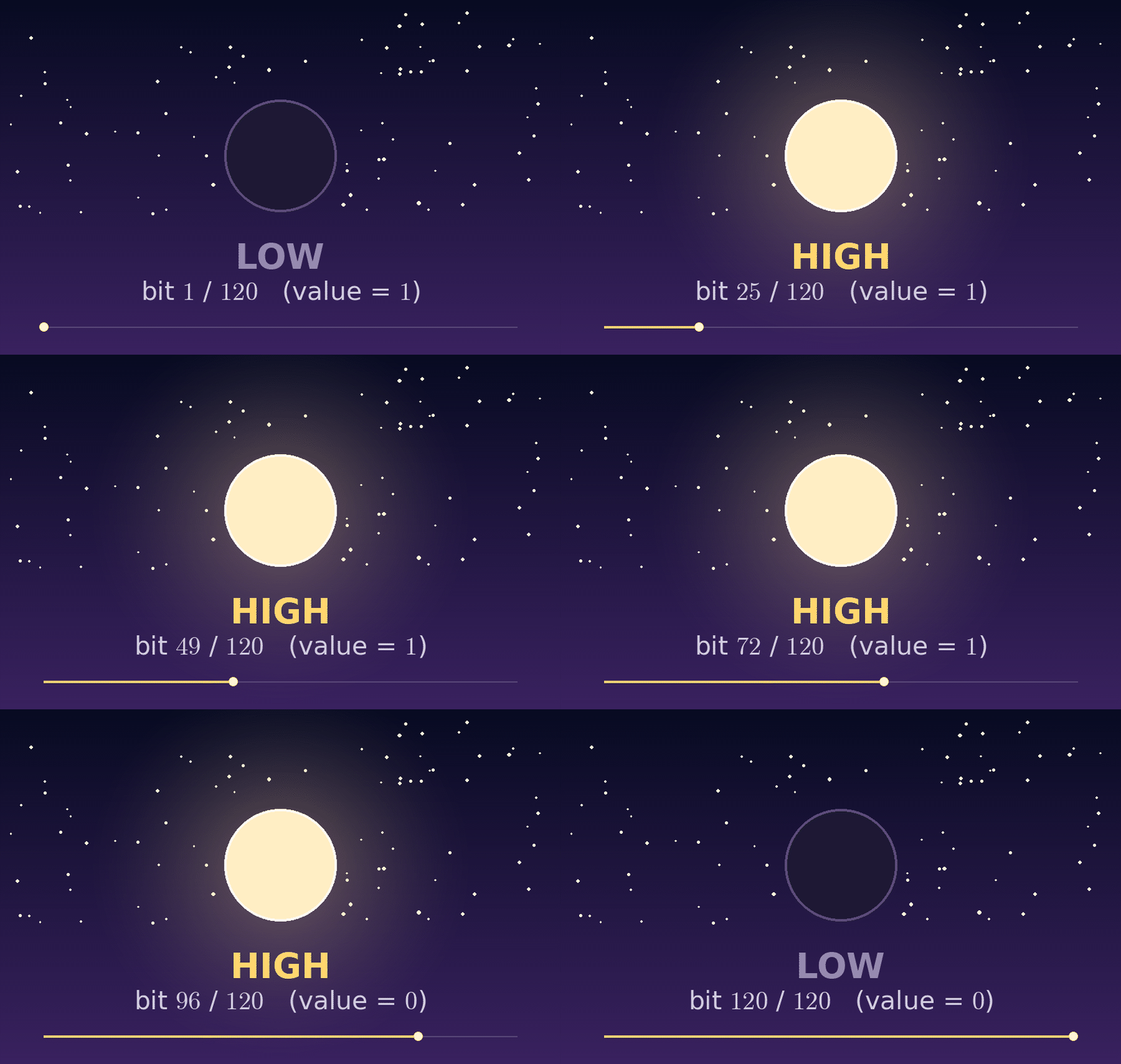 Final Message sent using Huffman code over NRZ-I+4B5B encoding
Now, we have a code on top a code on top of another code, since our message was initially encoded using Huffman code, the result of which was encoded using the 4B5B scheme, and finally we used NRZ-I to convert those bits into flashlight blinks. To decode this mess, your friend will need to revert all these encodings in reverse order, they will start by converting flashlight lows and highs to binary data, which is then they will decode similar to how we decoded a fixed-length encoding scheme ASCII before to get back to data encoded using Huffman, and finally they will use the Huffman tree to get back the original message. Phew!
The entire flow looks like below
Conclusion
We have reached the goal of the problem, you now know how to communicate with your best friend efficiently (don’t forget this was set-in 1900s :), and hopefully you learnt interesting things through this journey. Formally, we explored ways of sending raw data in the Physical Layer, which is the lowest level among the layers of Internet.
Though there is a lot more to be said, especially for Channel Coding and Cryptographic Coding, I hope with this problem I have ignited enough interest for you to start your own journey with Coding Theory. I have added a few7 interesting8 videos9 about Error-Correcting Codes, feel free to check them out10. And you can leave any questions/feedback for me in the comments section.
If you have read all of my long-winded chat, I genuinely thank you. Apologies for the abysmal grammar and poor writing. I wasn’t able to work on it as much as I wanted to. Still, I will get back and tidy this up (once the event finishes). And with that I finally take leave ✌️
References
This beautiful problem from the book Code: The Hidden Language of Computer Hardware and Software by Charles Petzold inspired me to build ideas on top of it and create this blog post with my own narrative. ↩︎
Huffman Codes: An Information Theory Perspective by Reducible ↩︎
Glitch text generated using Glitch Text Generator – Coddy ↩︎
The Hidden Geometry of Error-Free Communication by AnotherRoof ↩︎
I built a QR code with my bare hands to see how it works by Veritasium ↩︎
What Are Reed-Solomon Codes? How Computers Recover Lost Data by vcubingx ↩︎
Initially, I had this grand plan where I was also planning to introduce Channel Coding in this same post. But, then the post would have been $>70$ minutes long and absolutely no one would read it (at least no humans); and also, the above videos released, which discussed $60-70\%$ of things that I wanted to say, decreasing my motivation. So for now, これはこれ、それはそれ ↩︎